
A new patio is one of the simplest ways to get more use out of an Austin backyard. Choosing the surface is the hard part. The same 20-by-20-foot patio can cost under $2,000 or more than $10,000, depending on the material and finish. The ground changes across the area, from swelling clay on the east side to thin soil over limestone in the Hill Country. And in an Austin summer, how hot the surface gets underfoot matters.
We build all three: paver patios, poured concrete patios, and natural flagstone and native limestone through our custom stonework team. This guide compares what each costs, how each holds up here, what goes under a patio that lasts, which permit and tree rules to check, and what a fair quote should include.
How much does a paver patio cost in Austin compared with flagstone and concrete?
Plain poured concrete usually costs the least up front. Pavers land in the middle, and flagstone costs the most. The figures below come from Lawn Love's 2026 national cost guides for paver, flagstone, and concrete patios. They include materials and labor. They are not our quotes and not verified Austin prices.
- Plain gray concrete slab: $4 to $9 per square foot, or about $1,600 to $3,600 for a 20x20 patio (our math from that range)
- Concrete, all finishes: $4 to $26 per square foot, or $1,600 to $10,400 for 400 square feet
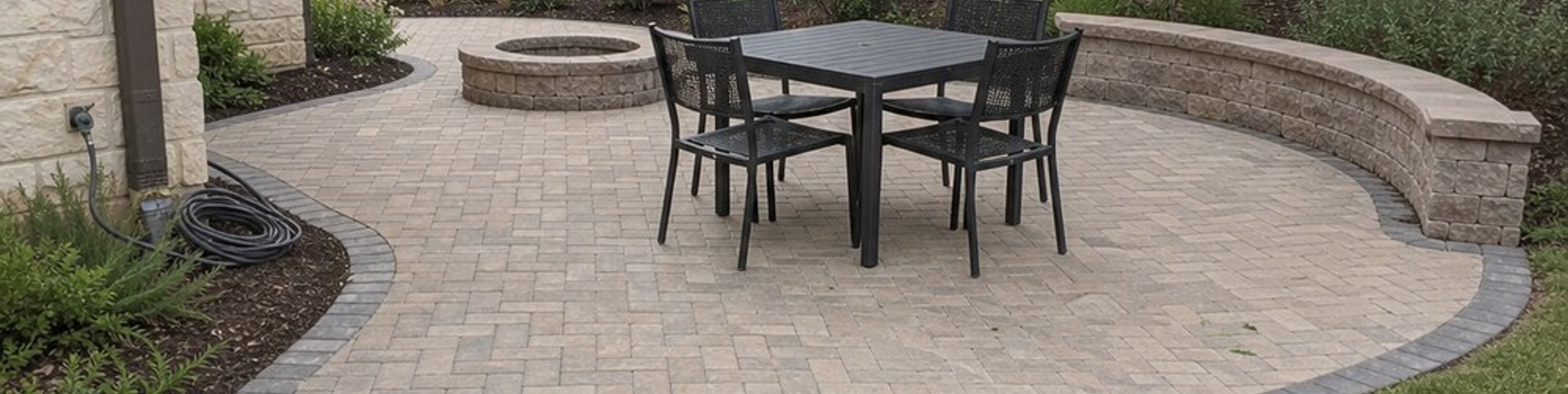
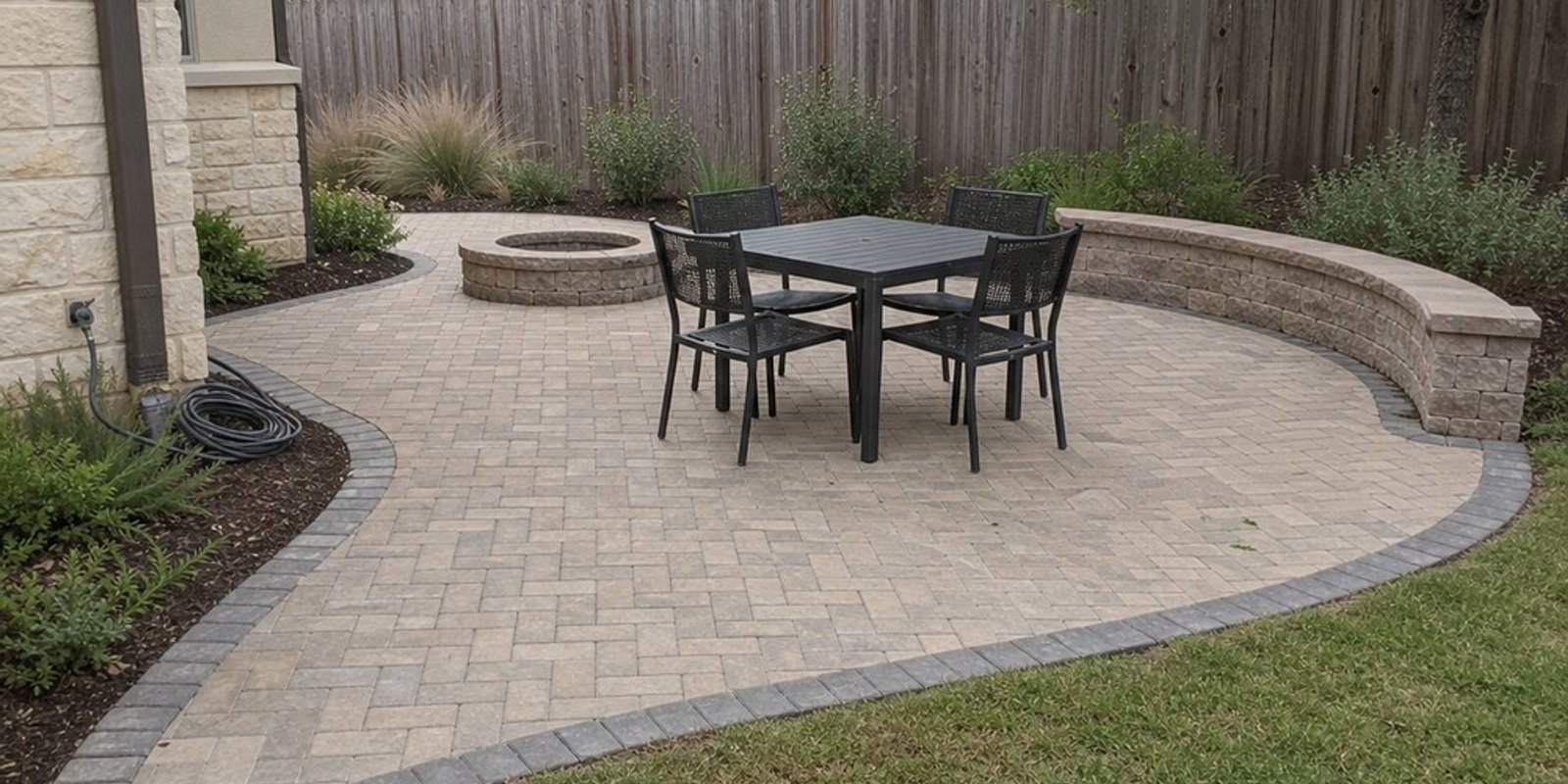
- Pavers: $8 to $24 per square foot, or $3,200 to $9,600 for 400 square feet
- Flagstone: $15 to $27 per square foot, or $6,000 to $10,800 for a 20x20 patio
Concrete spans the widest range because the finish matters. A plain broom-finish slab sits at the bottom, and stamped or stained finishes cost more. Paver prices swing with the material, from concrete pavers to natural stone.
What makes one Austin patio quote higher than another?
Labor and site work often move the number as much as the material does. Lawn Love lists paver installation labor at $5 to $15 per square foot and flagstone labor at $11 to $15 per square foot. What changes an Austin bid:
- Digging and base. On clay, we dig deeper and build a heavier base than most of the country needs. On Hill Country lots, hitting rock slows the dig.
- Access. A narrow side yard with no room for equipment means more work by hand.
- Tearing out an old slab. Demolition and hauling add cost.
- Pattern and extras. A herringbone or curved design takes more cutting than a straight grid. Steps, borders, and seat walls add labor and material.
- Drainage and trees. Grading water away from the house adds to the job, and a large tree nearby can change the layout.
Pavers or poured concrete: which holds up better in Austin?
Both can last for decades when the base is built for the site. They fail in different ways.
Clay and limestone
Much of the east side of the Austin area sits on Blackland clay that swells when it is wet and shrinks when it dries. West of town, many Hill Country lots have only 4 to 20 inches of soil over limestone. Our driveway guide explains both soils in more detail.
Pavers are separate pieces set over a flexible base, so they can move a little with the soil without cracking the whole surface. If one sinks or cracks, it can be lifted and reset. A concrete slab is one rigid piece. Clay movement can crack it, so we cut control joints to guide where it flexes. A repair on concrete is also harder to hide.
Heat underfoot
No hard surface stays cool in full summer sun. The EPA cites an Arizona study where asphalt reached up to 152°F at midday, while paving designed to reflect more sunlight stayed 10 to 16°F cooler. Lighter colors are a good start. We talk through paver and stone colors during planning because darker pavers hold more heat. For real relief, plan for shade. Our pergola or covered patio guide compares the options.
Upkeep
- Pavers: Expect to top off joint sand now and then, and reset any paver that settles. We lock the joints with polymeric sand when we build.
- Concrete: A plain broom finish needs little care. Stamped or colored concrete should be resealed every few years to protect the color from the sun. Our stamped and decorative concrete gives a slab the look of stone.
Is flagstone worth the extra cost, and should it be set in gravel or on concrete?
It is if you want real stone and can budget for the hand labor. Flagstone is natural stone split into flat, irregular slabs, the Hill Country look that stamped concrete tries to copy. It costs more mostly because each piece is fitted by hand. There are two main ways to set it:
- Dry-laid: Stones sit on a compacted gravel and sand base, with gravel, decomposed granite, or low plants in the gaps. Lawn Love puts a dry-laid flagstone patio at $1,515 to $5,200 total. It feels natural and lets some rain soak into the joints. Stones can shift a little, and the joint fill needs topping off.
- Wet-laid on concrete: Stones are mortared onto a concrete slab. Lawn Love lists $1,535 to $7,935 total. You get a firm, even surface that is easier for tables and chairs. But the slab underneath can crack with clay movement like any concrete.
Ask about the stone itself, too. We favor native limestone for much of our stonework because it weathers well in our sun and wet-dry cycles.
Can pavers go straight on the dirt, and what base does an Austin patio need?
No. Pavers or flagstone set on bare dirt will sink and shift, and on Austin clay that happens fast. The base does most of the work. Here is what goes under a paver patio we build:
- We dig to the right depth for your soil. Clay needs a deeper dig and a heavier base.
- We spread and compact a gravel base.
- We screed a thin leveling layer of sand or screenings.
- We set each paver by hand, add edge restraints, and lock the joints with polymeric sand.
- We grade the surface so rain runs away from your house.
The industry's guide specification from the Concrete Masonry & Hardscapes Association calls for about 1 inch of bedding sand. It also calls for compacting both the soil and the gravel base to at least 98% standard Proctor density for pedestrian areas, and notes that weak or saturated soil may need to be stabilized first.
When you compare bids, ask how deep each contractor will dig, what base they will use, how thick it will be, and how they will compact it. If one bid is far lower, ask whether the base is thinner.
Can you extend an existing patio, and which material blends in best?
Yes. Two of our Google reviews come from homeowners who had us extend their patio and add a pergola. The tricky part is the seam between old and new. A few options:
- Pour more concrete. It usually costs the least, but new concrete can look different from a slab that has weathered for years.
- Frame it with pavers or stone. A paver or flagstone border around the old slab makes the change in material look planned.
- Cover the old slab. Some homeowners set thin pavers or stone over an old slab that is still sound. That raises the surface, so check door thresholds and drainage first. If the old slab is cracked or sinking, replacing it is usually the safer plan.
Whichever you choose, the new section has to match the height and slope of the old one so water still drains away from the house. If you are torn between materials, we can show the options side by side in a 3D rendering before we build.
Do you need a permit, HOA approval, or a tree review for a new patio in Austin?
Often you will not need a building permit, but other rules can still apply.
- City of Austin permits. The City lists "concrete flatwork that is not located in the public right-of-way" as work exempt from a residential building permit. Exempt work still has to follow city codes, including limits on how much of your lot can be covered by hard surfaces. Our driveway guide explains those impervious cover limits.
- Trees. On residential property, the City of Austin regulates trees 19 inches or more in diameter. Each one has a critical root zone, a circle around the trunk with a radius in feet equal to the trunk's diameter in inches. No impacts are allowed in the inner quarter of that zone, no cut or fill over 4 inches is allowed in the inner half, and half of the full zone must stay undisturbed. Work that may disturb the root zone needs a Tree Ordinance Review Application, even when no building permit is required.
- Other cities. Rules change outside Austin. In Georgetown, the City has its own patio and flatwork permit process, with a site survey showing impervious cover, 15 to 20 business days for plan review, and inspections before the pour.
- Your HOA. If you have an HOA, check whether it reviews patio size, material, or color. Get any approval in writing before you sign a contract.
What should a patio quote include, and how do you choose a contractor in Austin?
A good quote lets you compare bids line by line. Look for:
- Square footage and a drawing of the layout
- The exact material: paver style and color, flagstone type and thickness, or concrete finish
- Excavation depth, base material and thickness, and compaction
- Bedding, joint fill, and edge restraints for pavers or flagstone, or slab thickness, reinforcement, and control joints for concrete
- How the patio will slope and where the water will go
- Demolition, extras, tree protection, permits, and HOA paperwork
- Timeline, payment schedule, and what the workmanship guarantee covers
Then ask: What happens if you hit rock? Can I see a finished patio like the one you are proposing?
Here is how we work. We walk your property, talk through how you want to use the space, and give you a clear written estimate for free. One in-house team designs and builds, the owner is involved on every job, and our work carries a workmanship guarantee.
Ready to plan a patio for your Austin backyard?
Pavers, flagstone, and concrete can all make a great patio. The right one depends on your soil, your shade, your budget, and how you use the space. Contact us to schedule a free design consultation. We will walk your yard, talk through the options, and give you a written estimate for the patio that fits it.