



Corten Steel & Metal Planter Boxes in Austin, TX
512 Luxury Landscape Design designs, welds, and installs custom Corten steel and metal planter boxes across Austin and the Hill Country. We build steel planter boxes for all kinds of spots: a pair of box planters for an entry, a run of pool-surround boxes, or a set of terraced planters down a slope, all sized to your site instead of to a catalog. Corten weathers to a deep rust-orange finish and then holds. You never paint it, seal it, or replace rotted boards.
Schedule An Estimate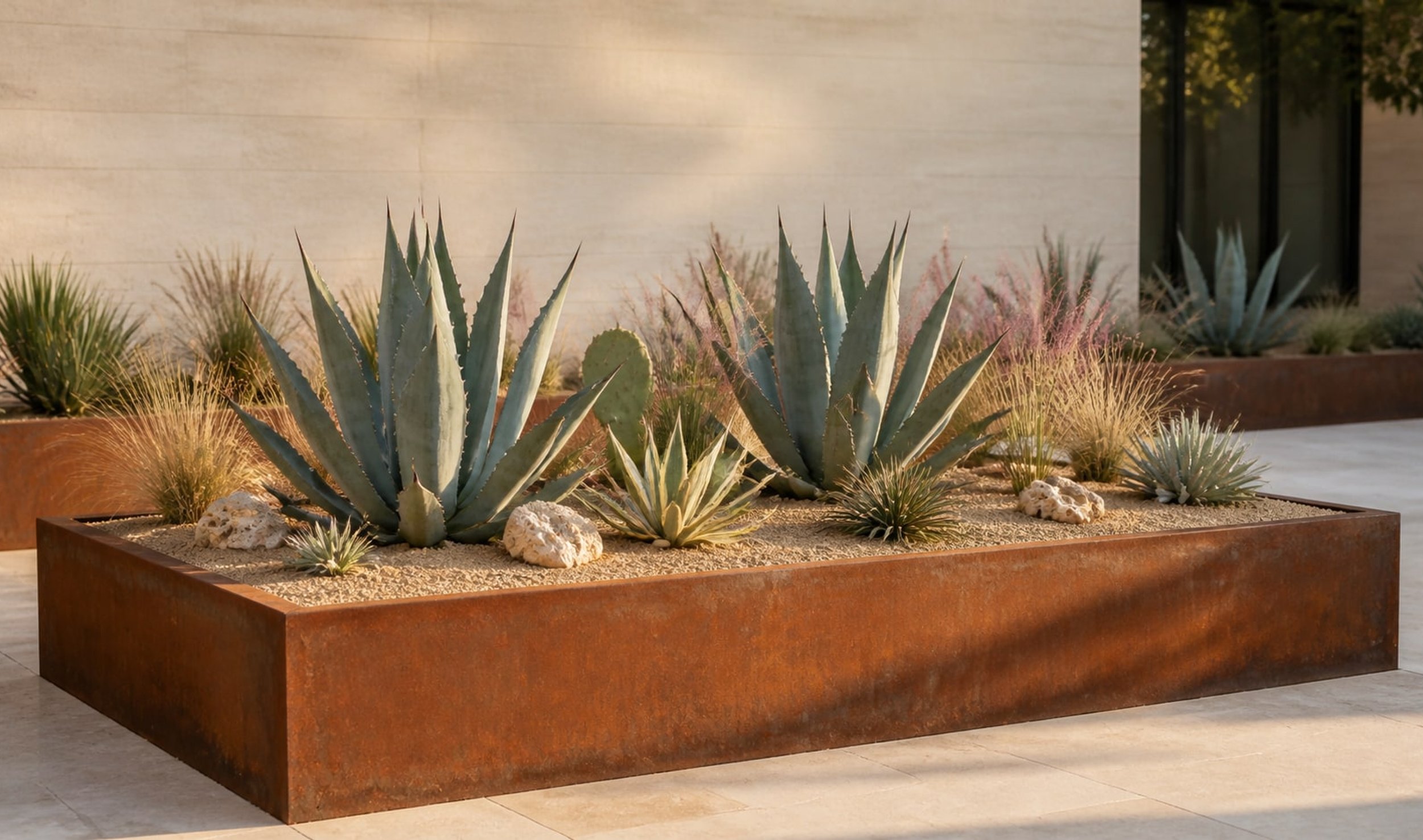
Weathering Steel That Finishes Itself
Corten is a weathering steel. Copper, chromium, and nickel in the alloy make the first layer of rust seal the surface instead of eating through it. That is why a Corten planter keeps its shape for decades with no paint and no sealer. A cedar bed in the same spot commonly needs replacing in 10 to 15 years, and an untreated pine or fir bed goes much sooner than that. Every planter we build is cut and welded to the size, shape, and depth your site needs, then set level on ground we prepped for it.
Our Customer Reviews
- Stafford Ullrich Google review ·Read on Google: review by Stafford Ullrich (opens in a new tab)
We had a fence and some landscaping done and it came out amazing. The work was completed quickly and they did a great job.
- Michael Williams Google review ·Read on Google: review by Michael Williams (opens in a new tab)
It was great working with Ean to remove our grass and replace with a xeriscape design. He took my vision and some specific plant selections and came up with a design that accomplished exactly what I wanted. I would recommend him and his team for your landscape needs!
- Adan Vasquez Google review ·Read on Google: review by Adan Vasquez (opens in a new tab)
enjoy working with Ean and his crew, always easy to communicate with.
- Anna Valenzuela Google review ·Read on Google: review by Anna Valenzuela (opens in a new tab)
Very pleased with how the driveway came out. Definitely recommend this company.
- Terry Kelley Google review ·Read on Google: review by Terry Kelley (opens in a new tab)
We had Ean and crew add an extension to our driveway and reroute sprinklers. The work was slows down by city permits issues but they were very patient with that and finished soon after permits were approved. Very happy with the work. Would use them again in a second.
- Karima King Google review ·Read on Google: review by Karima King (opens in a new tab)
We are very happy with the project/ service Ian and his team provided to us. Great communication, timely and very respectful. Would recommend 100 times! Thanks Ian and team!
- John Bitner Google review ·Read on Google: review by John Bitner (opens in a new tab)
Ean and his crew were great to work with. Newly poured driveway included a beautiful glued rock drain which not only protects but adds a touch of color to the concrete. Would highly recommend 512 Luxury Landscape Design.
- Kim San Miguel Google review ·Read on Google: review by Kim San Miguel (opens in a new tab)
Ian was so easy to work with and really communicative. We had our backyard redone with sod and he found the grass that would work best for our yard and gave us in depth instructions on how to make sure it roots and grows. His team was efficient and they did a fantastic job. We’re so excited to see how it does and would absolutely recommend for anyone looking for landscape design.
- I SanMiguel Google review ·Read on Google: review by I SanMiguel (opens in a new tab)
Ean and his crew were quick, efficient, respectful, and easy to deal with. He gave a fair price for a sod install. He showed up on time, did the work as agreed upfront, and left us with the nice lawn to enjoy. Thanks Ean and crew!
- Skylar Saenz Google review ·Read on Google: review by Skylar Saenz (opens in a new tab)
Ean and the team at 512 Luxury & Design exceeded my expectations. He walked through the project with me, listened to my ideas, and added his own expert input. He then put everything together in a digital format and sent it over for review. When the team arrived, they brought the vision to life flawlessly. I highly recommend Ean and his team for their professionalism, creativity, and attention to detail!
- Kelly Roles Google review ·Read on Google: review by Kelly Roles (opens in a new tab)
512 Luxury landscaping is a solid choice in your landscaping and construction needs! Ean and his crew do impeccable work, kind, timely, and is the best contractor I’ve ever worked with! What sets Ean apart is that he aims to educate the client. I’ve worked with many contractors that just do-as-told and then show up with their crew and you’re in shock, not knowing the process and procedures. Construction and landscaping is much more meticulous, strategic and demands strong communication than the novice knows- until they experience it for the first time. Ean is professional, communicative, has creativity and a best-bang-for-your-buck-attitude. There were times when I needed someone to step in a take control and he knew exactly when to do this- whilst simultaneously balancing knowing that as the customers, we need full transparency of what needs to happen and what to expect. Ean was additionally helpful calling out prior contractors incorrect work. So much to the point where I was empowered with the knowledge he gave me to call-out said contractors to come back and do the job the right way. You can’t go wrong with 512 luxury landscaping. I’ve referred many friends to them and hope this review is helpful to you making your decision on hiring a contractor.
- Virginia Dalbeck Google review ·Read on Google: review by Virginia Dalbeck (opens in a new tab)
I really enjoyed working with Luxery Landscape Design. Super professional, always on time and they get the job done. Also, all things they planted lasted many seasons and don’t die off which was nice… I definitely recommend.
- Amelia Johnson Google review ·Read on Google: review by Amelia Johnson (opens in a new tab)
I couldn’t be happier with the work 512 Luxury Landscape Design did on my backyard. They designed a stunning outdoor living area complete with a fire pit, custom stonework, and gorgeous plant selections. The attention to detail was impeccable, and the team worked efficiently to bring my vision to life. Now, my family and I spend more time outside than ever before, and entertaining guests has never been more enjoyable. Highly recommend their services for anyone looking to elevate their outdoor space!
- Pablo Salazar Google review ·Read on Google: review by Pablo Salazar (opens in a new tab)
Ean and his crew did a great job in our backyard renovation. Very friendly, would recommend!
- Norma Miller Google review ·Read on Google: review by Norma Miller (opens in a new tab)
512 Luxury Landscape Design added a patio extension which included a pergola cover. The owner was easy to communicate with, stayed on top of things and did not let the job drag on, and ensured the job was completed to satisfaction. It was a pleasure working with them!
- Dana Gutierrez Google review ·Read on Google: review by Dana Gutierrez (opens in a new tab)
Dream yard realized! These landscape architects are incredible artists; they turned my area into an opulent haven.
- Jack Coffey Google review ·Read on Google: review by Jack Coffey (opens in a new tab)
Several friends referred me to 512 Luxury Landscape Design for my latest home improvement project and we're glad they did. They installed a concrete sidewalk, outdoor wall sconce, and river rock landscape treatment. We think landscaping with rock is great because it cuts down on maintenance of having to add mulch seasonally. Fair pricing, great communication, and creative design ideas is why it was a pleasure working with Ian and his entire team. We highly recommend Luxury Landscape Design the next time you want to elevate your outdoor space.
- Nekeda Boggs Google review ·Read on Google: review by Nekeda Boggs (opens in a new tab)
I looked all over for a reasonable priced gazebo. Had no luck. I was referred to 512 Luxury Landscape and the process went seamlessly. Ean and his team were prompt and did an exceptional job building my gazebo. I absolutely love it.
- Nick Kelly Google review ·Read on Google: review by Nick Kelly (opens in a new tab)
Loved working with 512, local, attention to detail and transparent. Thank you!
- Braxton Peck Google review ·Read on Google: review by Braxton Peck (opens in a new tab)
Have used Ean and his crew for a handful of jobs. Quality work and material , great communication, and professional. Would highly suggest for any landscaping project.
- Jesse DeNucci Google review ·Read on Google: review by Jesse DeNucci (opens in a new tab)
Excellent service and professionalism along with a personal touch neighborly kindness. It says a lot when you can higher a company that takes as much pride in their work as this company. As a business owner myself, its unfortunately too hard to find a company that stands by their work AND their customer. 512 will impress you. Thanks team!
- Yuyu Chen Google review ·Read on Google: review by Yuyu Chen (opens in a new tab)
Had the pleasure of having them modify our home's surrounding, and I must say it was really impressive. If y'all are looking for someone to do landscaping, definitely consider this company.
- J F Google review ·Read on Google: review by J F (opens in a new tab)
Ean is always friendly and informative. Highly recommend. 🌱
- Lacey Kapetanis Google review ·Read on Google: review by Lacey Kapetanis (opens in a new tab)
Great company and great ownership! If you’re looking for a company that is reliable, amazing work ethic / finishing product and personable, you will most definitely want to get in touch with the owner, Ean!
- Jasmin H-C Google review ·Read on Google: review by Jasmin H-C (opens in a new tab)
It has been a pleasure working with Ean. Consultation, design and execution was performed professionally. Communication was flawless and so was the project result. Loved the additional ideas he provided and the result exceeded my expectations. Couldn’t be more happy. Thank you so much!!!!
- Margo Wickersham Google review ·Read on Google: review by Margo Wickersham (opens in a new tab)
Ean Nambo has a great eye for design and practicality that is more important for Austin area homeowners now than ever. We had a functional problem of water pooling at our front door during heavy rains. We had a design problem of a front yard that was 20% grass and 80% weeds that required mowing and turned brown during droughts. I challenged Ean to help me create a xeriscaped front yard that diverts water away from our house and into the street and that looks like the updated and modern home that we've created. I wanted to avoid installing a lawn that would be thirsty for water in our climate and I had some ideas for including a dry creek running through the property. I am thrilled with the results! I love the look and the dry creek bed did its job during a recent deluge. Ean had ideas to make the most of a courtyard area that converted the space into an additional gathering area and I couldn't be happier with the result. He also included dramatic landscape lighting installation that showcases the lovely texture of the limestone exterior and the grace of our live oaks that have survived the recent freezes. I wanted to avoid over planting, so as we planted a few things. I'm happy with this strategy, because I can see which plants work best in which areas for future plantings. Rarely can a homeowner say they are so happy with the results of working with a landscape company, so I am thrilled to share met experience with others considering 512 Luxury Landscaping.


Why Austin Homeowners Choose Us for Custom Corten Steel Planters
A steel planter has to sit level, stay square, and drain clean on the ground you actually have.
Rated 4.8 on Google
28 homeowners have reviewed us on Google, with an average of 4.8 out of 5 stars. Read our Google reviews
Designing and Building Since 2018
One in-house team designs and builds your project, so there is no handoff between a designer and a separate crew. The owner stays involved from the first walk-through to the final cleanup.
Bases Detailed for Rock or Clay
West of the fault, limestone sits within about a foot of the surface, so we level and pin to rock. On the shrink-swell clay to the north and east, we widen the footprint or build a base to spread the load. We also detail the base so rust runoff drips clear of pale patios and pool decks.
Custom Steel & Metal Planter Boxes in Austin, TX
WELDED TO FIT, SET LEVEL, BUILT TO STAYA planter box is one of the few things in a yard that is both structure and plant bed at once. It has to hold soil weight, drain, sit level against a hard edge, and still look like it belongs. 512 Luxury Landscape Design fabricates custom Corten steel planters and other metal planter boxes for homes across Austin, Westlake, Lakeway, and the Hill Country, then installs them ourselves. Nothing gets subbed out between the weld and the set. This page is part of our welding and steel fabrication services.
How We Build and Set Your Planters
Every planter is made to order, so it fits the spot instead of forcing the spot to fit it:
- We visit the site, measure, and check what the planter will sit on and where the water will go.
- We size depth to the planting, not to a standard height. Root depth is what keeps soil temperature stable in our summers.
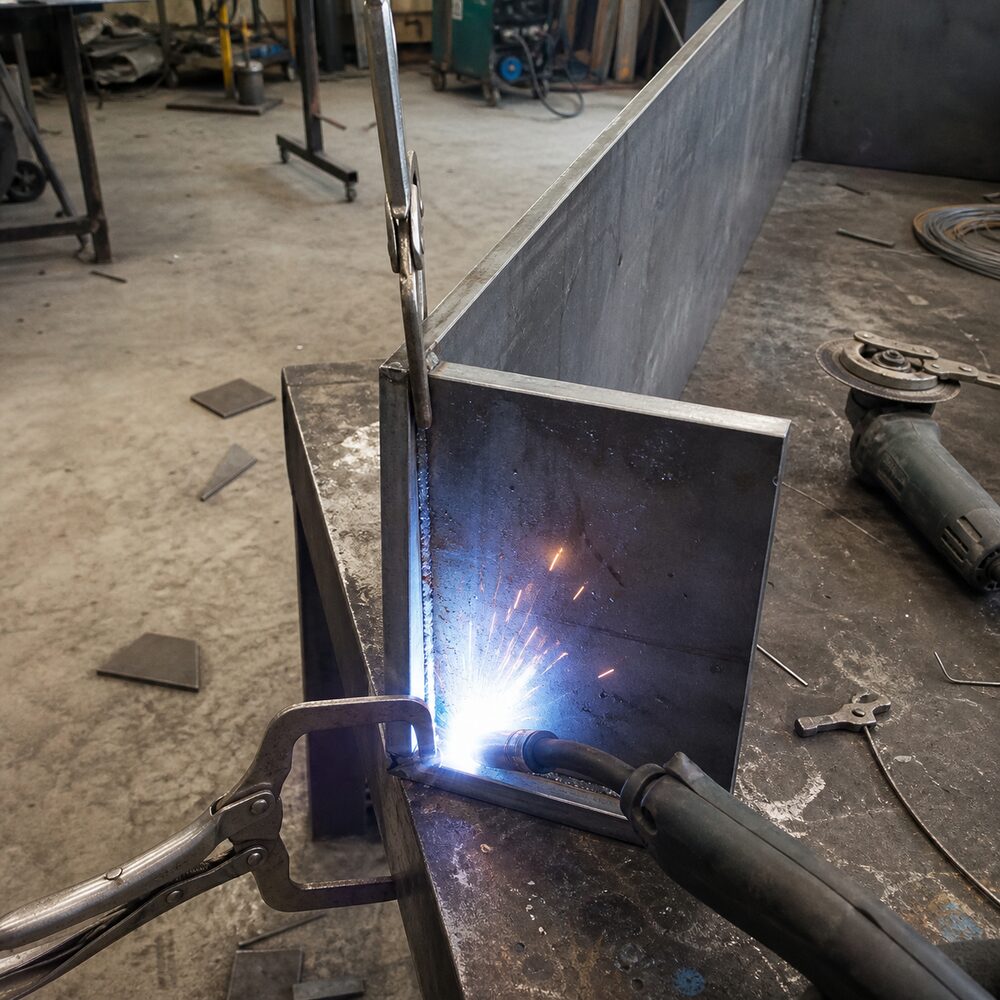
- We cut and weld the panels in shape: rectangles, squares, troughs, rounds, L-shapes, corners, and stepped tiers.
- We grind every edge smooth so nobody gets cut reaching into a bed.
- We prep the base, set the planter dead level, and detail the drainage so water leaves the bottom instead of standing in it.
Call (512) 785-2754 to set up a free on-site visit.
Types of Steel Planter Boxes We Build
Corten works for far more than a vegetable bed. Because we cut and weld each one, the same material covers a lot of very different jobs:
Entry and Driveway Planters
Matched pairs that frame a front door or a motor court. These are usually the most visible steel on the property, so we take extra care on corner welds and consistent panel height.
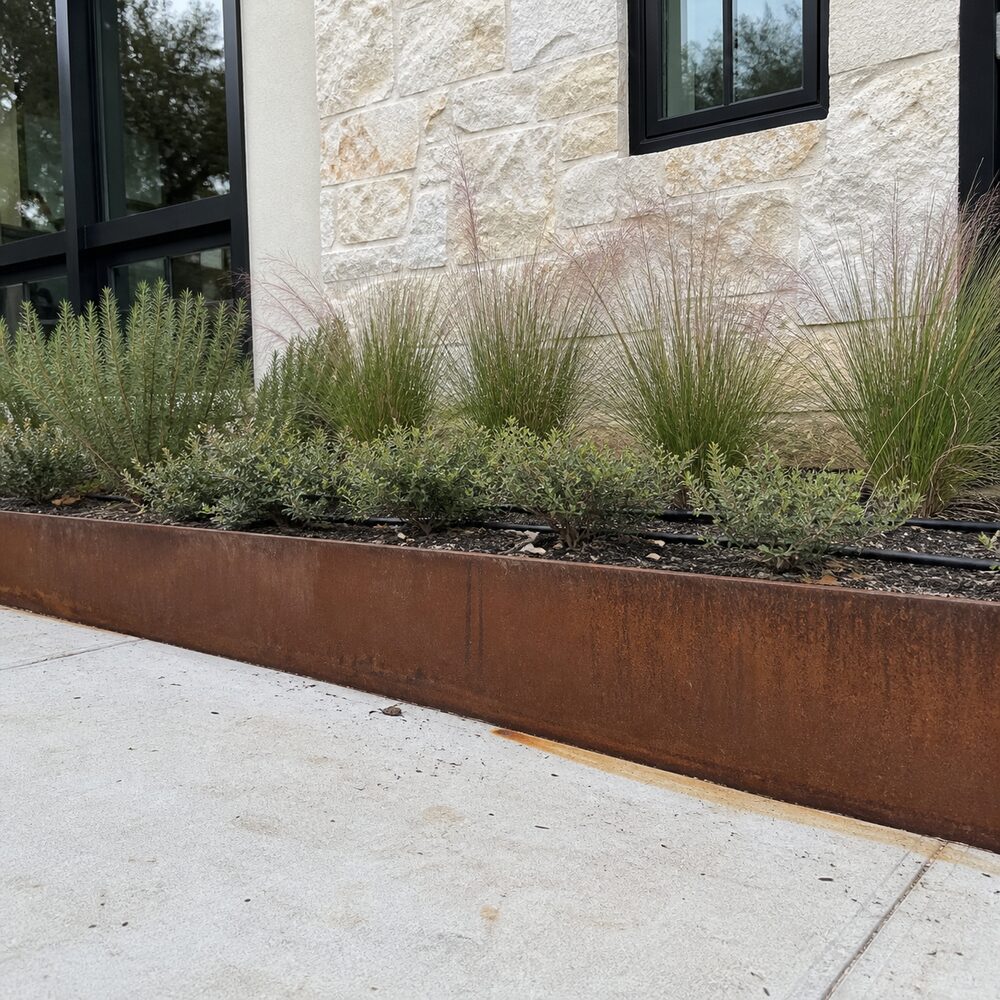
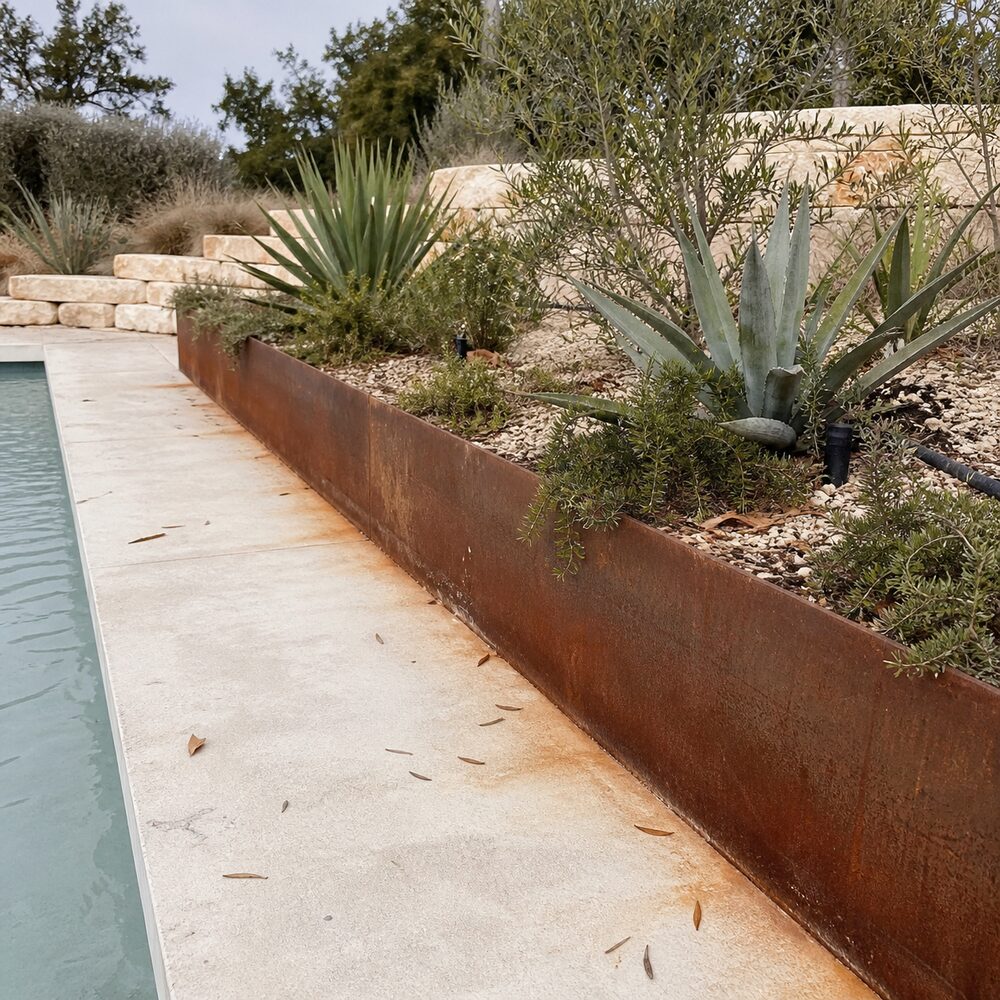
Patio and Pool-Surround Planters
Long low runs that soften a hard edge and give a pool deck some structure. On light-colored decking we detail the base so iron-stained runoff does not sheet across the concrete.
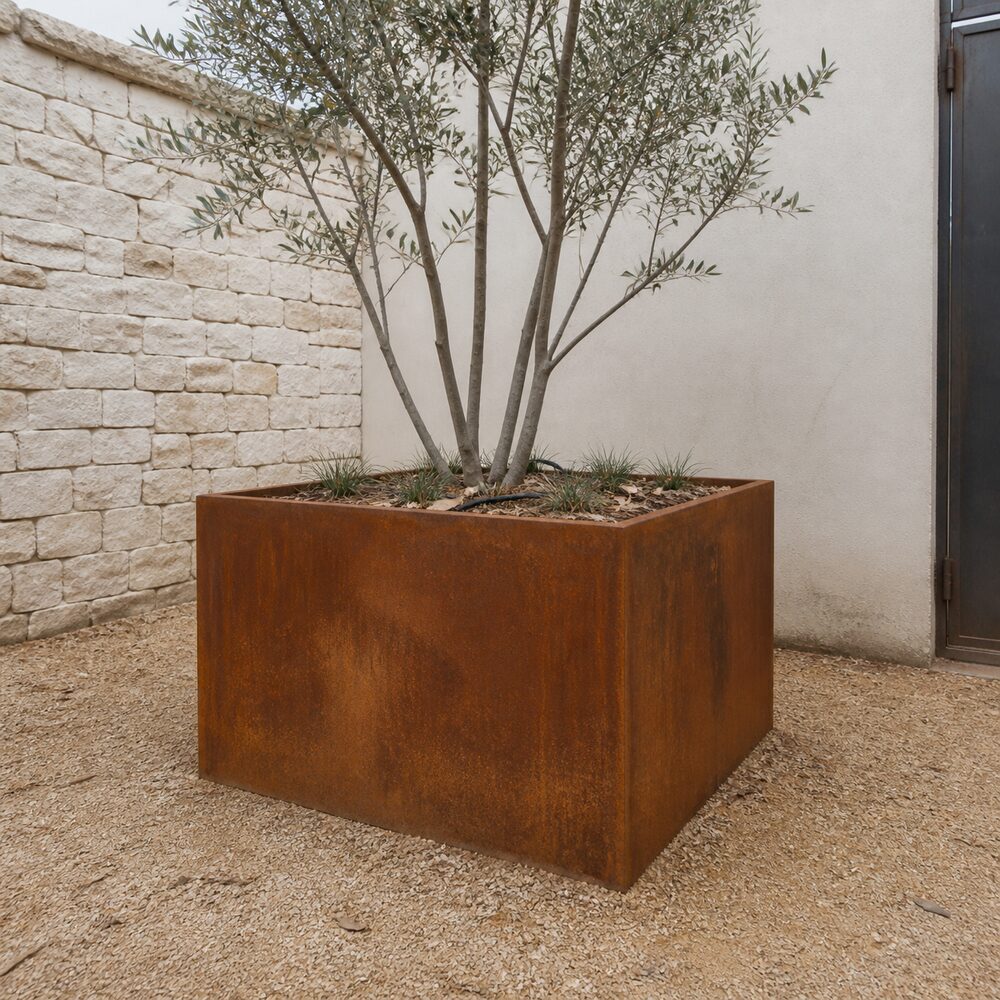
Tree Planters
Deep, wide boxes that hold enough soil volume for a multi-trunk specimen. Depth and drainage matter more here than anywhere else, because you do not get a second chance once the tree is in.
Screening and Privacy Planters
Tall planters that carry a hedge or a row of grasses up to eye level. A good option where a fence would be blocked by setbacks or an HOA, or where you just want green instead of more fence.
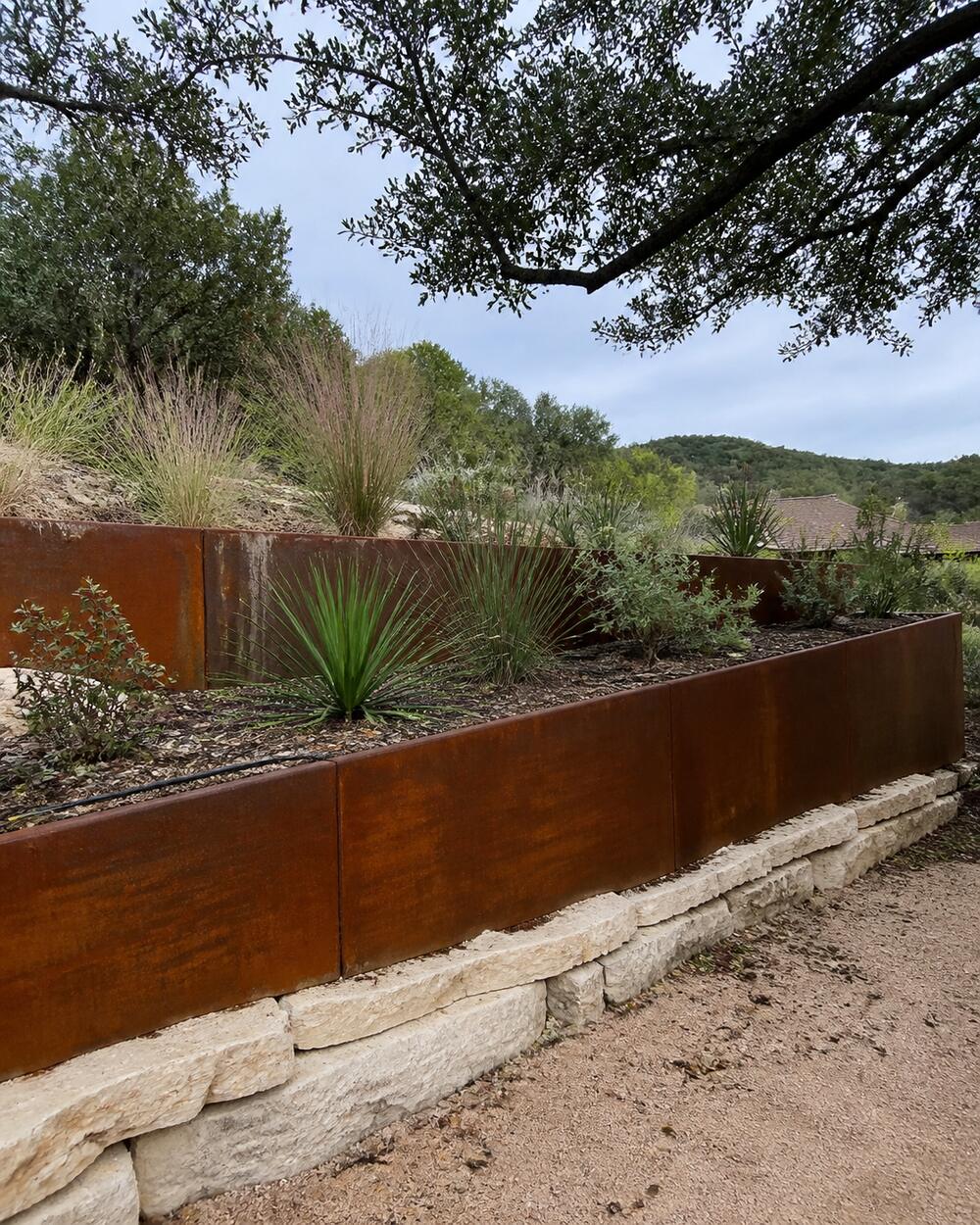
Retaining and Terraced Planters
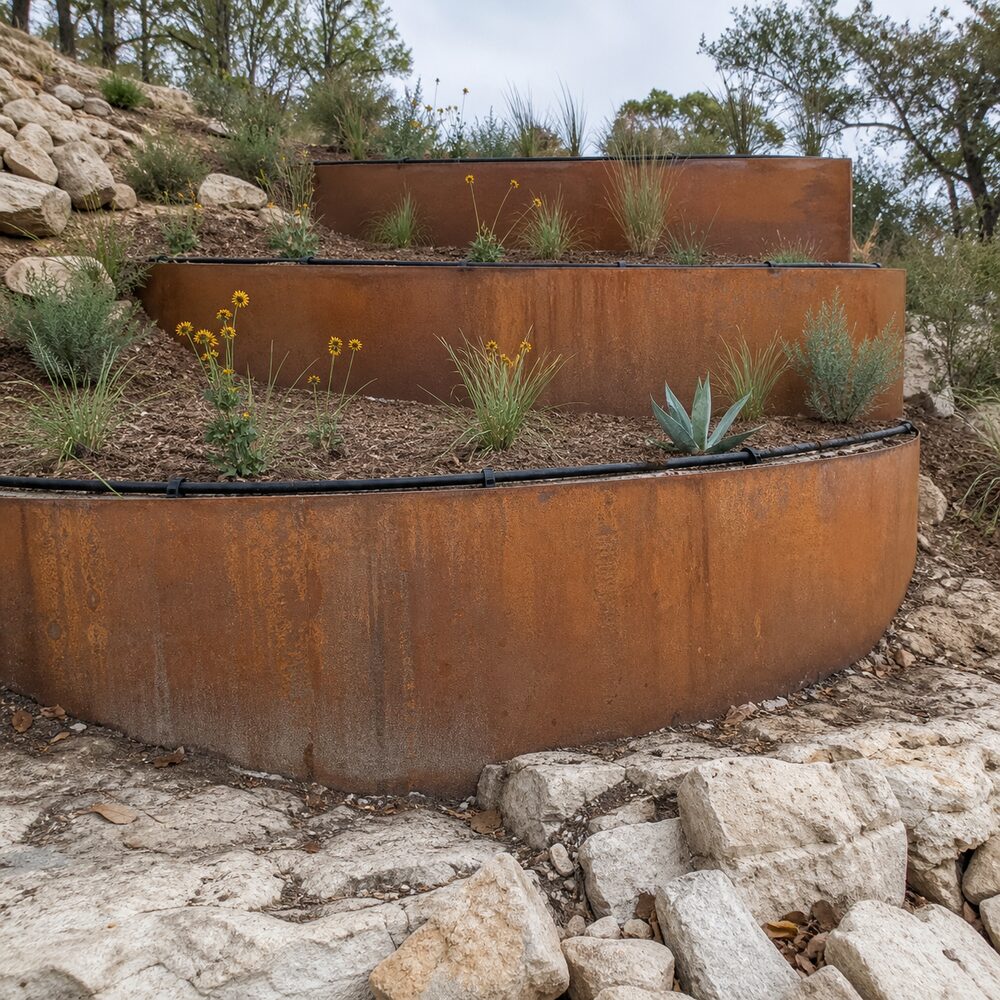
Stepped boxes that hold a slope and turn it into usable planting. This is the type most likely to trigger a permit or an HOA review, and we sort that out before we cut steel.
Raised Beds for Food
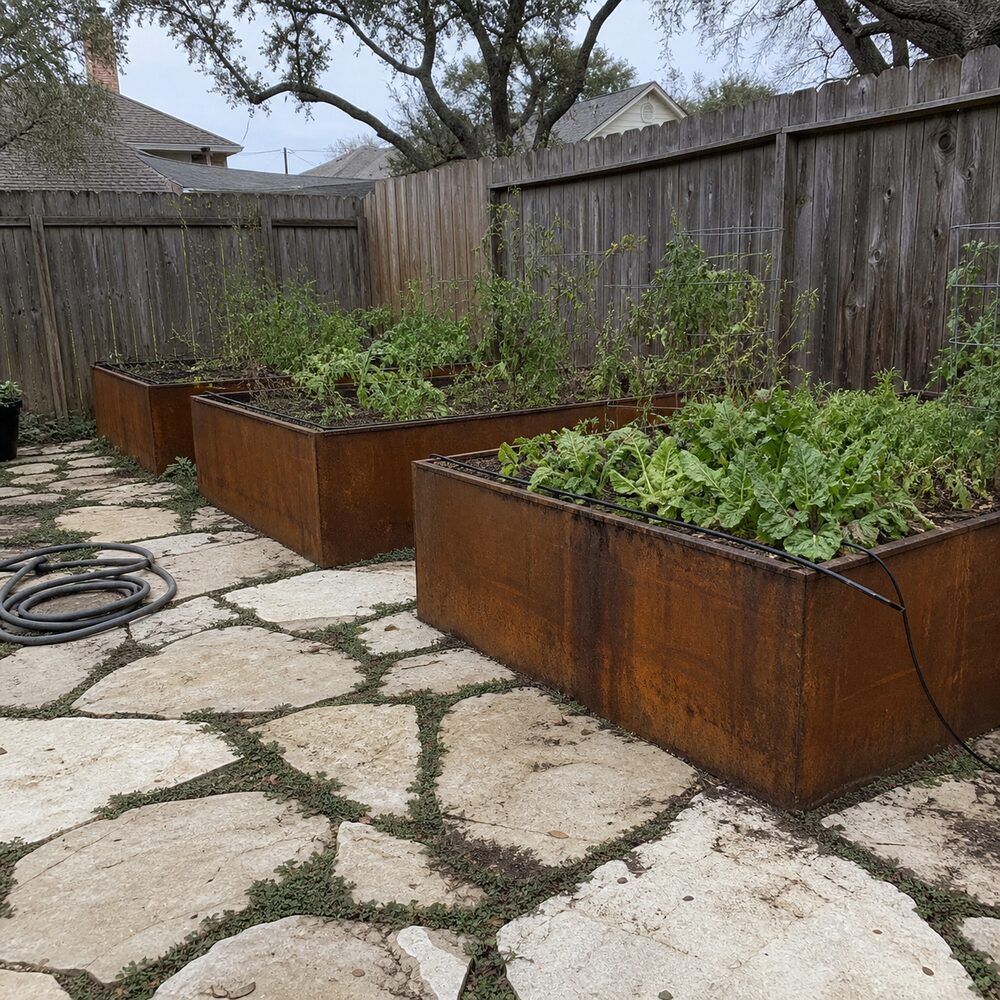
Corten raised garden beds for vegetables and herbs, sized deeper than a decorative planter so roots stay cooler through July and August.
Round and Trough Planters
Rolled circular planters and long narrow troughs for courtyards, side yards, and tight balconies.
Modular and Repeating Runs
A set of matched planters at consistent spacing, which reads as designed rather than assembled.
Corten Steel vs Cedar, Concrete, and Galvanized
Corten is not automatically the right answer. Here is where it wins and where it does not:
Corten vs Cedar Raised Beds
Cedar costs less up front, and it is a genuinely good material. It is rot-resistant, and a cedar bed commonly lasts 10 to 15 years. What shortens that is constant moisture at the bottom edge where soil meets wood, which is exactly what drip irrigation does. Cedar also greys and cups long before it actually fails, so most people replace it on looks rather than on failure. Corten holds its shape and its line for decades and never needs sealing. If you plan to garden in the same spot for the long haul, steel costs less per year even though it costs more per bed. If you might move the beds in a few seasons, cedar is the sensible call.
Corten vs Concrete Planters
Concrete gives you mass and a cooler wall. It is also heavy, hard to move once poured, prone to hairline cracking, and difficult to fit to an odd shape without formwork. Corten walls are thin, so you get more soil volume inside the same outside dimension. That matters in a narrow side yard or on a patio where every inch of footprint is spoken for.
Corten vs Galvanized Steel
Both are steel and both outlast wood by a wide margin. Galvanized keeps a bright silver finish and never bleeds rust onto anything, which makes it the safer pick directly on light concrete or right against a painted wall. Corten gives you the warm orange-brown color that reads well against limestone, native grasses, and modern architecture. We build in both, and we will tell you honestly when galvanized is the better fit for your spot.
Corten vs Stone or Masonry Planter Walls
Masonry looks permanent and matches Hill Country stone work, but it needs a real footing, takes longer to build, and costs more for the same retained height. A steel planter goes in faster with less excavation, which is a genuine advantage on a rocky lot where every inch of dig is slow. Worth knowing: some HOAs require masonry. Steiner Ranch's design manual states that all retaining walls must be native white limestone with a dry-stack appearance, unless the architectural committee approves something else. A steel terrace planter there has to go through that approval first.
Ready for planters that outlast the landscape around them? Contact 512 Luxury Landscape Design to schedule your free on-site consultation.
Get Started with Corten Planters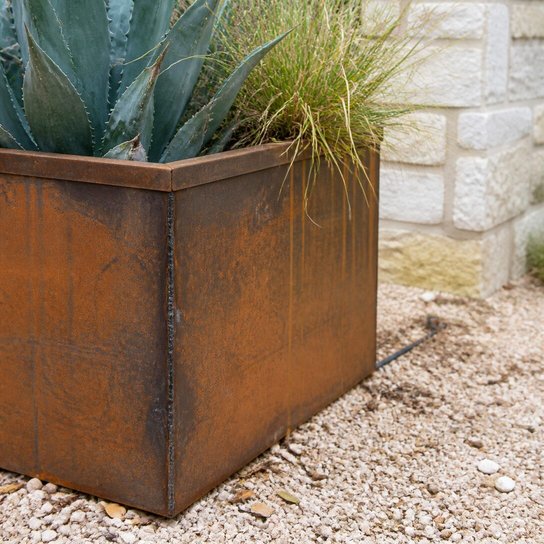
What Austin Ground and Local Rules Mean for Your Planters
Where a planter goes in matters as much as how it is built. Austin sits on the Balcones Fault Zone, and the ground changes character over a few miles. These are the conditions we plan around:
- Shallow rock west of the fault. The upland soils in Westlake, Rollingwood, and Barton Creek are thin limestone residuum. The USDA soil series that map here, Tarrant and Brackett, run roughly 6 to 20 inches down to limestone. A buried footing is not realistic. We level and pin to rock instead, and we bring breaking equipment when the base needs to be cut in.
- Shrink-swell clay to the north and east. North and northeast Austin sit on Blackland Prairie clay that moves with the season. A heavy planter set straight on that clay will tilt over time, so we widen the bearing footprint or build a proper base to spread the load.
- Rust runoff on light hardscape. Federal Highway Administration guidance on uncoated weathering steel notes that water running off bare steel carries iron oxide onto whatever it lands on. On a limestone patio, a pale pool deck, or a driveway apron, we detail the base so runoff drips clear instead of sheeting across the slab.
- Retaining height triggers a permit. Inside Austin city limits, a retaining wall is exempt from a building permit only if it is not over 4 feet measured from the bottom of the footing to the top of the wall, is not supporting a surcharge, and is not in a flood hazard area. Terraced planters cross that line more often than people expect.
- Tree rules are stricter than most people think. Austin regulates any tree 19 inches or more in diameter measured 4.5 feet above the ground, and Heritage trees of certain species are protected at 24 inches. West Lake Hills requires a permit to remove trees or vegetation from any property. We keep planters and their excavation clear of protected root zones.
- HOA and jurisdiction vary by street. West Lake Hills has its own city code, not Austin's. Steiner Ranch calls for retaining walls in native white limestone unless its architectural committee approves otherwise. Circle C's architectural committee reviews hardscape changes. Around Lake Travis, LCRA's Highland Lakes Watershed Ordinance governs land-disturbing work. We confirm which rules apply to your address before we fabricate.
- Access decides the build. On steep, narrow Hill Country lots we may weld a large planter on site rather than crane a finished box over a house. We work that out during the free consultation, not on install day.
We install Corten steel planters in Austin, Barton Creek, Bee Cave, Dripping Springs, Lakeway, Leander, Oak Hill, Rollingwood, Spicewood, Tarrytown, and Westlake.
Corten Steel Planter Box FAQs
Does Corten steel stain concrete?
It can, and you should plan for it. Federal Highway Administration guidance on uncoated weathering steel notes that water running off bare steel carries iron oxide with it and can stain what it lands on. The heaviest bleed happens while the patina is still forming. On a limestone patio, a light-colored pool deck, or a driveway apron, we set the planter on a small reveal. Runoff then drips to soil or gravel instead of sheeting across the slab. We can also add a drip edge or a sealed base detail. Tell us at the site visit if the planter sits on light concrete, because that changes how we build the base.
How long does Corten steel take to rust?
It starts within days. Corten begins to darken almost immediately once it is outside, and in the Austin climate it usually reaches an even orange-brown tone over the first several months. The patina keeps deepening and settling for a year or two after that. Wet and dry cycles are what drive the process, so a planter in full sun with regular irrigation colors up faster than one under deep cover. The steel looks raw and grey when we deliver it. That is normal and it is not a defect.
How long do Corten steel planters last?
Decades. The alloy is designed so the first layer of rust seals the surface. That layer slows further corrosion instead of feeding it, which is why Corten holds up without paint or sealer. For comparison, a cedar raised bed commonly lasts 10 to 15 years. A Corten planter is a one-time build. Thickness and drainage are what decide its life. We spec the steel gauge to the size of the planter and make sure water can get out of the bottom.
Do Corten steel planters get too hot for plants in Texas?
The wall gets hot in afternoon sun, but the soil in the middle of the planter stays much cooler than the wall does. Depth is what protects roots. A shallow planter bakes no matter what it is made of, so we size depth for what you are growing rather than defaulting to a standard height. On a west-facing wall or a pool deck we can go deeper, use a wider planter, or set the box where it gets afternoon shade. For food crops we usually recommend at least 18 inches of soil depth.
Do Corten steel planters need to be lined?
Not for the steel's sake. Corten is meant to be exposed, and lining the inside does not make the planter last meaningfully longer. There are two real reasons to line one. First, if the planter sits against a house wall, a wood fence, or a light-colored hardscape and you want to keep iron-stained water off it. Second, if you want to slow moisture loss in a tall narrow planter. If we do line one, we leave the drainage path open. A sealed liner with nowhere for water to go will drown roots faster than heat will.
Are Corten steel planters safe for growing vegetables?
Yes. Corten is a low-alloy structural steel, and the surface rust it forms is stable iron oxide that stays put rather than moving through the soil. Plenty of Austin gardeners grow food in weathering steel beds. If it is a vegetable bed, tell us at the consultation, because we will usually recommend more depth and we will pay closer attention to how the bed drains. That matters more for what you harvest than the metal does.
Do I need a permit for a Corten planter in Austin?
A freestanding planter box normally does not need one. It changes once the planter is holding back a grade, because then it is a retaining wall. Inside Austin city limits, a retaining wall is exempt from a building permit only if it is not over 4 feet measured from the bottom of the footing to the top of the wall. It also has to not be supporting a surcharge, such as a driveway or a slope pushing against it, and it cannot sit in a flood hazard area. Some of our service areas are stricter. West Lake Hills requires a permit to remove trees or vegetation from any property, and Austin regulates any tree 19 inches or more in diameter measured 4.5 feet up. HOA rules can be tighter still: Steiner Ranch's design manual calls for retaining walls to be native white limestone unless its architectural committee approves otherwise, so a steel terrace planter there needs approval first. We check jurisdiction and HOA before we fabricate.