



Landscaping in Cedar Park, TX
Landscaping in Cedar Park starts with rock, since much of the city sits on a few inches of stony clay over hard limestone. 512 Luxury Landscape Design plans and builds yards for that ground: native beds, drip irrigation that fits the city's watering rules, stone patios, concrete, shade, and custom steel. One in-house team designs and builds, the owner is involved on every job, and we are rated 4.8 stars from 28 Google reviews. Estimates are free.
Schedule An Estimate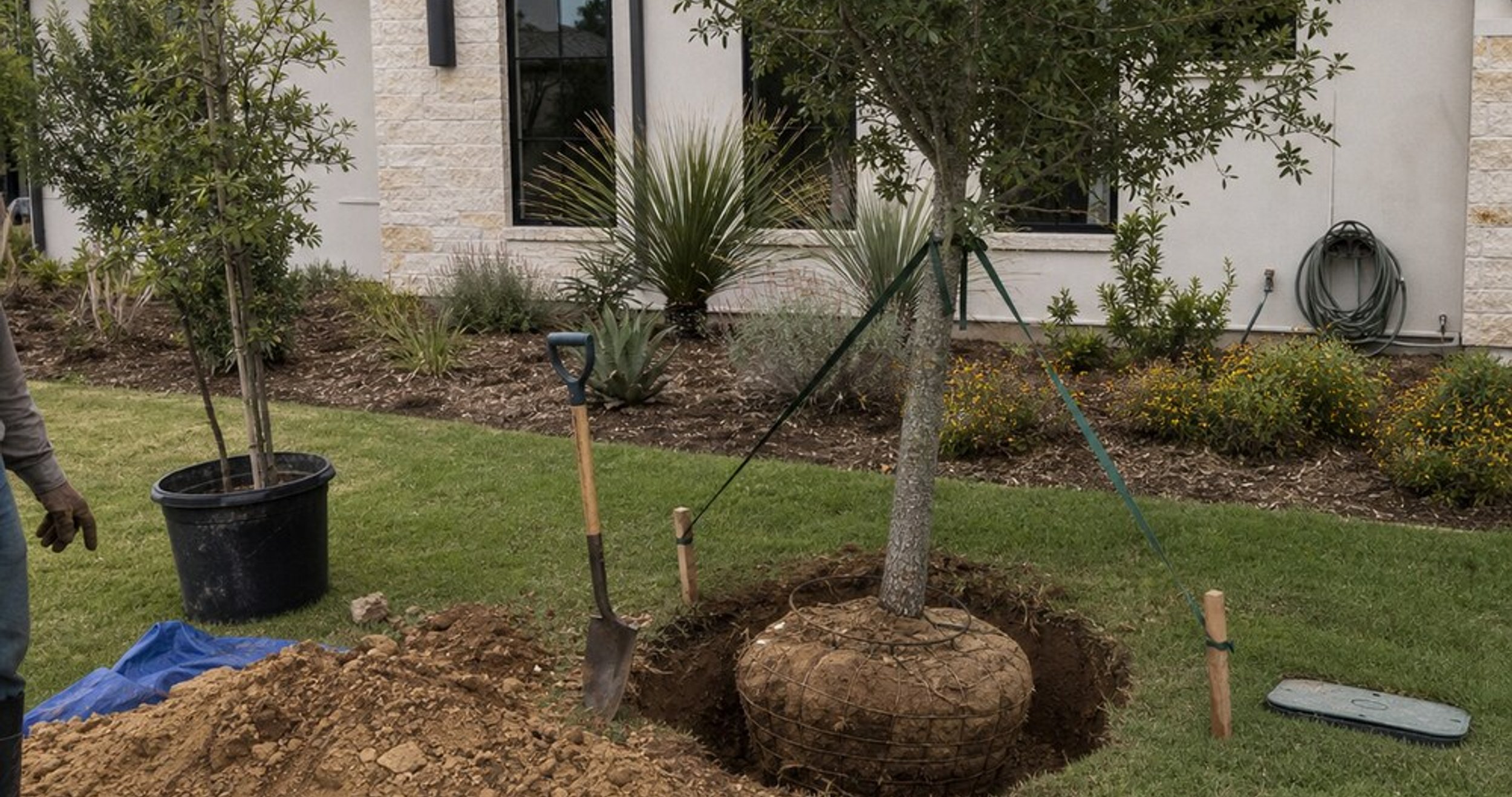
Landscaping Built for Cedar Park's Rock and Water Rules
Cedar Park sits about 16 miles northwest of Austin, mostly in Williamson County with a small part in Travis County. The town grew up on limestone, and quarried building stone was one of its main products from the 1890s until about 1970. That same rock is why a shovel stops short in so many Cedar Park yards today. Federal soil maps show Eckrant soils here with only 4 to 20 inches of dirt over hard limestone. The town also grew fast, from about 3,500 people in 1980 to 77,595 at the 2020 census. Most homes went up in 2000 or later. City code asks new homes for a sodded front lawn, two shade trees, and a few shrubs, and many yards still have little more than that. City water comes from Lake Travis, under watering rules that tighten when the lake drops. Good landscaping in Cedar Park plans for all three: rock, heat, and water. We have designed and built outdoor spaces since 2018, and we build Cedar Park yards to look good and hold up on this ground.
Landscaping Services in Cedar Park, TX
BUILT FOR ROCK, HEAT, AND LAKE TRAVIS WATEROne in-house team can take your Cedar Park yard from tired builder sod to a finished outdoor space. Here is what we build, starting with the work Cedar Park homeowners ask about most.
Landscaping in Cedar Park
On thin soil over limestone, roots have nowhere to go. We check how deep the rock sits before we plant, then bring in good soil and build up beds where the rock is close. For lawns, we prep the ground before any sod installation, so the grass is not sitting on a few inches of caliche. For tree installation, we pick shade trees from the city's preferred plant list, like live oak, cedar elm, and Shumard red oak. We size the hole for the root ball, even if it means cutting into rock.
Landscape Design in Cedar Park
Cedar Park's baseline water rule allows sprinklers two days a week, and only before 10 a.m. or after 7 p.m. In Stages 1 and 2, drip lines and soaker hoses can run on any day, at any time. In Stages 3 and 4, they are limited to your one watering day, and Stage 4 also limits the hours. That makes drip irrigation design the smart choice for beds here. Our xeriscaping uses native, drought-tough plants that need less water. The city's preferred plant list points to the same place: the Grow Green guide and the LCRA plant list.
Hardscaping & Masonry in Cedar Park
Limestone is part of Cedar Park's story, and it still looks right here. Because many lots slope and the rock sits close to the top, we build retaining walls in Cedar Park that turn a slope into flat, usable yard. We set footings on solid ground, not loose fill, and add drainage behind the wall. We also build outdoor kitchens, paver patios, and fire pits that tie into the stone on your home.
Welding & Steel Fabrication in Cedar Park
Cedar Park does not require a permit for a fence, but its code sets the rules. Side and rear fences can be up to 8 feet tall. In the front setback, fences are usually capped at 3 feet. On a lot over 20,000 square feet, a wrought iron fence up to 6 feet can go in front. We weld fences, metal gates, and steel planters in-house, so the design and the build stay with one team.
Custom Concrete in Cedar Park
Cedar Park ground changes from lot to lot. Some yards have hard rock a few inches down, while others have Crawford clay, which cracks open 1/2 inch to 2 inches wide when it dries out. We grade and prep the base to match the soil under your slab. Then we pour concrete patios, stamped concrete, walkways, and driveways with steel reinforcement and control joints.
Patios & Pergolas in Cedar Park
Austin's Camp Mabry weather station averages about 123 days a year at 90 degrees or hotter. A patio cover or a steel pergola makes the back yard usable through that long summer. Cedar Park requires a permit for arbors and for a structure built over an existing slab or deck. The city wants a site plan, a foundation plan, and inspections, so we draw the plans and build to them.
What Landscaping Costs in Cedar Park
We price every Cedar Park yard on its own, so we do not post flat numbers. A few local things move the cost. Rock is the big one: digging footings, tree holes, or irrigation trenches into limestone takes more time and heavier tools. Big oaks count too, since we work around their root zones. Permits add steps for patio covers, arbors, and irrigation systems, and many homes also need HOA approval. A front-bed refresh with drip lines sits at the low end. A full back yard with a retaining wall, covered patio, and outdoor kitchen sits much higher. We walk your property and give you a clear written estimate for free.
From Buttercup Creek to the Ranch at Brushy Creek, we build Cedar Park yards that work with rock, heat, and water rules.
Get a Free Estimate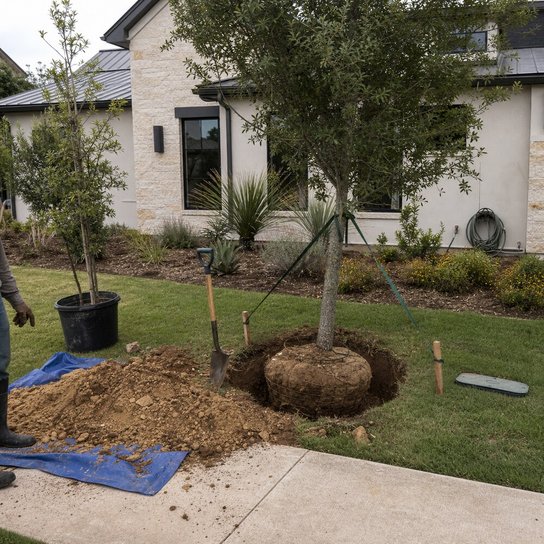
What Landscaping in Cedar Park Has to Deal With
Start with the ground. USDA soil maps show three common soils across Cedar Park. Eckrant stony clay has only 4 to 20 inches of soil over hard limestone, and some of it is bare rock outcrop. Doss silty clay reaches rock at 11 to 20 inches. Crawford clay is deeper, 20 to 40 inches, but it shrinks and cracks when it dries. That is why we check the soil on every lot before we price it. The rock below is karst, full of cracks and caves. The city says most of Cedar Park sits in the Recharge or Contributing Zone of the Edwards Aquifer. The U.S. Fish and Wildlife Service also maps a Cedar Park karst region, home to endangered cave creatures like the Bone Cave harvestman. If a dig opens a hole in the rock, we stop and look before we go on.
Water and weather come next. Cedar Park buys its water from Lake Travis through the LCRA. When the combined storage in Lakes Travis and Buchanan falls, the city's drought stages step up. In March 2025, dry weather pushed Cedar Park to Stage 3 and one watering day a week. At Stage 5, the city bans automatic sprinklers, and drip may only be used for trees, foundations, and vegetable gardens. The heat is steady: Austin's Camp Mabry station averages about 29 days a year at 100 degrees or hotter and about 12 nights at freezing or below. Hard freezes still happen, and Camp Mabry hit 7 degrees in February 2021. We choose plants rated for USDA zone 9a, which covers the 78613 and 78641 ZIP codes, and tough enough for both.
- Thin, stony soil over limestone means we test rock depth first, then import soil or raise beds where roots need room.
- Drip lines and soaker hoses can run on any day in Stages 1 and 2, and new landscapes can get one 21-day watering variance.
- Cedar Park's code makes it unlawful to remove a protected tree, or to remove or prune a heritage tree, without written city approval.
- The city requires permits for irrigation systems, arbors, gazebos, and patio covers over an existing slab.
- The city's HOA map lists about 80 neighborhoods with an HOA or neighborhood group, so many projects need design approval first.
Why Cedar Park Homeowners Choose Us
You want a crew that plans for rock, big oaks, and water rules before the first shovel goes in. We design and build in-house, and the owner stays on the job from the first walk-through to the final cleanup.
Full-Service Design and Build
One in-house team handles design, planting, irrigation, stone, concrete, shade, and steel. Nothing gets lost in a handoff between separate companies.
Owner Involved on Every Job
The owner stays involved from the first walk-through to the last detail, so you get straight answers and reliable follow-through.
We Plan for the Rock
We check soil depth and slope during the estimate. Your price and plan account for the limestone under your yard from the start.
Water-Wise by Design
We lay out drip zones and pick plants that fit Cedar Park's watering days, so your yard stays healthy when the city tightens the rules.
Plans Ready for Your HOA
We can prepare drawings and 3D renderings for your HOA review and the plans the city needs for a permit.
In-House Welding and Free Estimates
We build iron fences, gates, and pergolas in-house. We also walk your property and write up your estimate for free.
Our Customer Reviews
- Michael Williams Google review ·Read on Google: review by Michael Williams (opens in a new tab)
It was great working with Ean to remove our grass and replace with a xeriscape design. He took my vision and some specific plant selections and came up with a design that accomplished exactly what I wanted. I would recommend him and his team for your landscape needs!
- Terry Kelley Google review ·Read on Google: review by Terry Kelley (opens in a new tab)
We had Ean and crew add an extension to our driveway and reroute sprinklers. The work was slows down by city permits issues but they were very patient with that and finished soon after permits were approved. Very happy with the work. Would use them again in a second.
- Karima King Google review ·Read on Google: review by Karima King (opens in a new tab)
We are very happy with the project/ service Ian and his team provided to us. Great communication, timely and very respectful. Would recommend 100 times! Thanks Ian and team!
- John Bitner Google review ·Read on Google: review by John Bitner (opens in a new tab)
Ean and his crew were great to work with. Newly poured driveway included a beautiful glued rock drain which not only protects but adds a touch of color to the concrete. Would highly recommend 512 Luxury Landscape Design.
- Kim San Miguel Google review ·Read on Google: review by Kim San Miguel (opens in a new tab)
Ian was so easy to work with and really communicative. We had our backyard redone with sod and he found the grass that would work best for our yard and gave us in depth instructions on how to make sure it roots and grows. His team was efficient and they did a fantastic job. We’re so excited to see how it does and would absolutely recommend for anyone looking for landscape design.
- I SanMiguel Google review ·Read on Google: review by I SanMiguel (opens in a new tab)
Ean and his crew were quick, efficient, respectful, and easy to deal with. He gave a fair price for a sod install. He showed up on time, did the work as agreed upfront, and left us with the nice lawn to enjoy. Thanks Ean and crew!
- Skylar Saenz Google review ·Read on Google: review by Skylar Saenz (opens in a new tab)
Ean and the team at 512 Luxury & Design exceeded my expectations. He walked through the project with me, listened to my ideas, and added his own expert input. He then put everything together in a digital format and sent it over for review. When the team arrived, they brought the vision to life flawlessly. I highly recommend Ean and his team for their professionalism, creativity, and attention to detail!
- Kelly Roles Google review ·Read on Google: review by Kelly Roles (opens in a new tab)
512 Luxury landscaping is a solid choice in your landscaping and construction needs! Ean and his crew do impeccable work, kind, timely, and is the best contractor I’ve ever worked with! What sets Ean apart is that he aims to educate the client. I’ve worked with many contractors that just do-as-told and then show up with their crew and you’re in shock, not knowing the process and procedures. Construction and landscaping is much more meticulous, strategic and demands strong communication than the novice knows- until they experience it for the first time. Ean is professional, communicative, has creativity and a best-bang-for-your-buck-attitude. There were times when I needed someone to step in a take control and he knew exactly when to do this- whilst simultaneously balancing knowing that as the customers, we need full transparency of what needs to happen and what to expect. Ean was additionally helpful calling out prior contractors incorrect work. So much to the point where I was empowered with the knowledge he gave me to call-out said contractors to come back and do the job the right way. You can’t go wrong with 512 luxury landscaping. I’ve referred many friends to them and hope this review is helpful to you making your decision on hiring a contractor.
- Virginia Dalbeck Google review ·Read on Google: review by Virginia Dalbeck (opens in a new tab)
I really enjoyed working with Luxery Landscape Design. Super professional, always on time and they get the job done. Also, all things they planted lasted many seasons and don’t die off which was nice… I definitely recommend.
- Amelia Johnson Google review ·Read on Google: review by Amelia Johnson (opens in a new tab)
I couldn’t be happier with the work 512 Luxury Landscape Design did on my backyard. They designed a stunning outdoor living area complete with a fire pit, custom stonework, and gorgeous plant selections. The attention to detail was impeccable, and the team worked efficiently to bring my vision to life. Now, my family and I spend more time outside than ever before, and entertaining guests has never been more enjoyable. Highly recommend their services for anyone looking to elevate their outdoor space!
- Norma Miller Google review ·Read on Google: review by Norma Miller (opens in a new tab)
512 Luxury Landscape Design added a patio extension which included a pergola cover. The owner was easy to communicate with, stayed on top of things and did not let the job drag on, and ensured the job was completed to satisfaction. It was a pleasure working with them!
- Jack Coffey Google review ·Read on Google: review by Jack Coffey (opens in a new tab)
Several friends referred me to 512 Luxury Landscape Design for my latest home improvement project and we're glad they did. They installed a concrete sidewalk, outdoor wall sconce, and river rock landscape treatment. We think landscaping with rock is great because it cuts down on maintenance of having to add mulch seasonally. Fair pricing, great communication, and creative design ideas is why it was a pleasure working with Ian and his entire team. We highly recommend Luxury Landscape Design the next time you want to elevate your outdoor space.
- Nekeda Boggs Google review ·Read on Google: review by Nekeda Boggs (opens in a new tab)
I looked all over for a reasonable priced gazebo. Had no luck. I was referred to 512 Luxury Landscape and the process went seamlessly. Ean and his team were prompt and did an exceptional job building my gazebo. I absolutely love it.
- Braxton Peck Google review ·Read on Google: review by Braxton Peck (opens in a new tab)
Have used Ean and his crew for a handful of jobs. Quality work and material , great communication, and professional. Would highly suggest for any landscaping project.
- Jesse DeNucci Google review ·Read on Google: review by Jesse DeNucci (opens in a new tab)
Excellent service and professionalism along with a personal touch neighborly kindness. It says a lot when you can higher a company that takes as much pride in their work as this company. As a business owner myself, its unfortunately too hard to find a company that stands by their work AND their customer. 512 will impress you. Thanks team!
- Yuyu Chen Google review ·Read on Google: review by Yuyu Chen (opens in a new tab)
Had the pleasure of having them modify our home's surrounding, and I must say it was really impressive. If y'all are looking for someone to do landscaping, definitely consider this company.
- Lacey Kapetanis Google review ·Read on Google: review by Lacey Kapetanis (opens in a new tab)
Great company and great ownership! If you’re looking for a company that is reliable, amazing work ethic / finishing product and personable, you will most definitely want to get in touch with the owner, Ean!
- Jasmin H-C Google review ·Read on Google: review by Jasmin H-C (opens in a new tab)
It has been a pleasure working with Ean. Consultation, design and execution was performed professionally. Communication was flawless and so was the project result. Loved the additional ideas he provided and the result exceeded my expectations. Couldn’t be more happy. Thank you so much!!!!
- Margo Wickersham Google review ·Read on Google: review by Margo Wickersham (opens in a new tab)
Ean Nambo has a great eye for design and practicality that is more important for Austin area homeowners now than ever. We had a functional problem of water pooling at our front door during heavy rains. We had a design problem of a front yard that was 20% grass and 80% weeds that required mowing and turned brown during droughts. I challenged Ean to help me create a xeriscaped front yard that diverts water away from our house and into the street and that looks like the updated and modern home that we've created. I wanted to avoid installing a lawn that would be thirsty for water in our climate and I had some ideas for including a dry creek running through the property. I am thrilled with the results! I love the look and the dry creek bed did its job during a recent deluge. Ean had ideas to make the most of a courtyard area that converted the space into an additional gathering area and I couldn't be happier with the result. He also included dramatic landscape lighting installation that showcases the lovely texture of the limestone exterior and the grace of our live oaks that have survived the recent freezes. I wanted to avoid over planting, so as we planted a few things. I'm happy with this strategy, because I can see which plants work best in which areas for future plantings. Rarely can a homeowner say they are so happy with the results of working with a landscape company, so I am thrilled to share met experience with others considering 512 Luxury Landscaping.
- Adan Vasquez Google review ·Read on Google: review by Adan Vasquez (opens in a new tab)
enjoy working with Ean and his crew, always easy to communicate with.
- Anna Valenzuela Google review ·Read on Google: review by Anna Valenzuela (opens in a new tab)
Very pleased with how the driveway came out. Definitely recommend this company.
- Pablo Salazar Google review ·Read on Google: review by Pablo Salazar (opens in a new tab)
Ean and his crew did a great job in our backyard renovation. Very friendly, would recommend!
- Stafford Ullrich Google review ·Read on Google: review by Stafford Ullrich (opens in a new tab)
We had a fence and some landscaping done and it came out amazing. The work was completed quickly and they did a great job.
- Dana Gutierrez Google review ·Read on Google: review by Dana Gutierrez (opens in a new tab)
Dream yard realized! These landscape architects are incredible artists; they turned my area into an opulent haven.
- Nick Kelly Google review ·Read on Google: review by Nick Kelly (opens in a new tab)
Loved working with 512, local, attention to detail and transparent. Thank you!
- J F Google review ·Read on Google: review by J F (opens in a new tab)
Ean is always friendly and informative. Highly recommend. 🌱


Landscaping in Cedar Park, TX FAQs
Do I need a permit for a patio cover, pergola, or fence in Cedar Park?
For a patio cover or arbor, usually yes. Cedar Park requires a permit for accessory structures like arbors and gazebos. It also requires one for a cover built over an existing slab or deck, and for decks over 200 square feet or 30 inches high. The city asks for a site plan and a foundation plan, then inspects the layout, the footings, and the final build. A fence does not need a permit, but it must follow the city's fence code. New irrigation systems need a permit too. We confirm what your project needs with the city before we start.
What are Cedar Park's watering rules for a new yard?
In Stage 1, the city's baseline, homes water two set days a week based on the last digit of the address. Sprinklers can only run before 10 a.m. or after 7 p.m. Drip irrigation and soaker hoses can run on any day and at any time in Stages 1 and 2. In Stage 3 they follow your one watering day, and in Stage 4 they also follow set morning and evening hours. A new landscape can get one 21-day variance to water while it roots, with city approval, in Stages 1 through 3. In Stages 4 and 5, plan on no variance. That is why we plant new sod and beds with the current stage in mind, and lean on drip wherever we can.
Can I remove or trim a big oak on my Cedar Park lot?
Check with the city first, because Cedar Park's code makes it unlawful to remove a protected tree, or to remove or prune a heritage tree, without written approval from the city. Heritage trees are those 26 inches or more across, measured 4.5 feet above the ground. Timing matters too, since the Texas A&M Forest Service says to avoid pruning or wounding oaks from February through June, when oak wilt spreads most easily, and to paint any oak wound right away. When we build near big trees, we keep trenches, fill, and equipment off the root zone.
How do you build on Cedar Park's shallow, rocky soil?
We start by finding out what is under your yard. On Eckrant soils, hard limestone can sit just 4 to 20 inches down. There, we raise beds, bring in soil, and cut into the rock for footings and tree holes. On Crawford clay, the soil cracks as it dries and swells when wet, so we prep the base and reinforce concrete to handle the movement. Drainage matters on both. Since water runs off rock fast, we grade it away from your house and patios.
Which Cedar Park neighborhoods do you work in?
We take projects all over Cedar Park, in both the 78613 and 78641 ZIP codes. That includes Buttercup Creek, Cypress Creek, the Ranch at Brushy Creek, Twin Creeks, Silverado Ranch, and Carriage Hills, plus homes near Whitestone Boulevard and the 183A Toll Road. Most of these neighborhoods have an HOA, and many HOAs review yard changes before work starts. We can prepare the drawings for that review. Every project starts with a free visit to your property.
Does Cedar Park offer rebates for water-wise landscaping?
The city offers up to $100 in water bill credits for buying rain barrels. It also points customers to LCRA's water-saving rebate programs, which change from year to year, so check the current list before you plan. The biggest savings usually come from design. Native plants, drip lines, and less thirsty turf cut your water use every week. They also keep your yard healthy when the city moves to a stricter drought stage.