


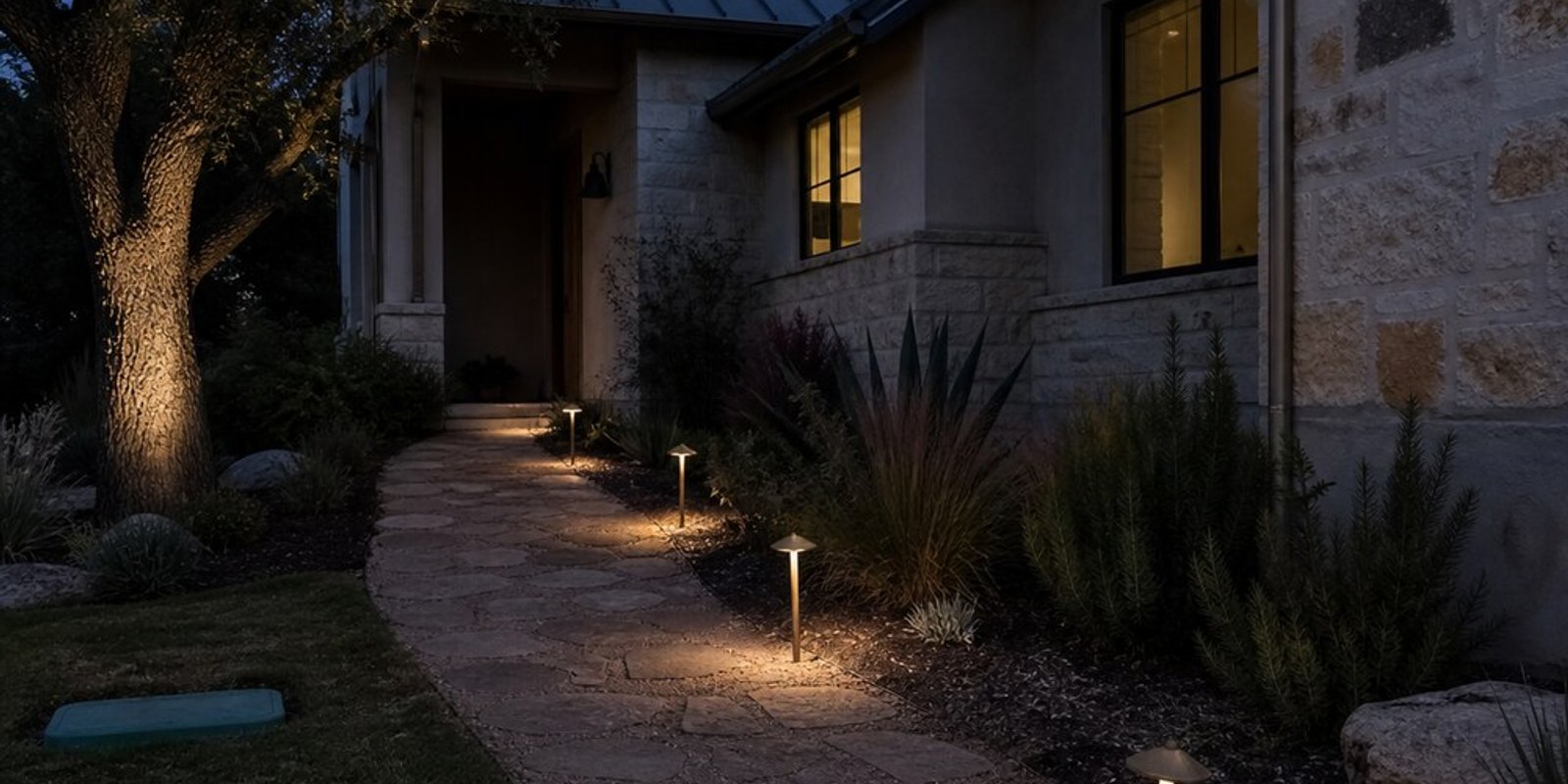

In Austin, the yard goes dark right when the evening finally gets comfortable. Normal high temperatures here stay above 90 degrees from late May into late September, so much of our outdoor time happens after sunset, and unlit steps and a dark patio cut it short.
Two things make this harder to fix than it should be. Landscape lighting quotes swing widely from one company to the next, and outdoor lighting rules are not the same in every city around Austin. We design and install low-voltage landscape lighting across the area, and this guide explains what it costs and how to read a quote so you can compare bids with confidence, even if you hire someone else.
How much does landscape lighting cost in Austin?
Most homeowners spend in the low thousands of dollars, but the range is wide. These are national published averages, not our quotes:
- HomeAdvisor (updated June 2026) puts the average around $4,000, with most projects between $3,000 and $6,000 and a full range of about $1,000 to $7,500.
- LawnStarter (December 2025) reports an average near $3,250, a typical range of $2,000 to $4,500, and about $100 to $200 per fixture.
Custom design-build systems with brass fixtures and a full plan tend to land above these aggregator averages, which one Austin company's 2020 figures suggested: an average project near $7,000 for about 21 fixtures.
Two things move the price most: how many fixtures you install, and what grade they are. A written estimate after an on-site visit is the only way to get a real number for your home. Good lighting also adds safety on steps and more usable evening hours.
Why do landscape lighting quotes vary so much?
Two quotes for "landscape lighting" can describe very different work. Here is what drives the gap:
- Fixture count. More fixtures means more materials, wire, and labor.
- Fixture material. Brass, copper, and stainless steel cost more than aluminum and hold up better outdoors.
- Transformer size and zones. A bigger system needs a larger transformer and may split into several zones.
- Wire runs and trenching. HomeAdvisor lists trenching at about $3 to $5 per linear foot nationally. Boring under a walkway or driveway adds cost.
- Controls. A simple timer costs less than a smart system you run from your phone.
- Night aiming. Adjusting fixtures after dark takes time, but it changes how the whole system looks.
Warranties show why material matters. Across major brands, brass, copper, and stainless fixtures usually carry warranties of roughly 10 years to lifetime, while aluminum finishes are often around 5 years. Aluminum can be fine in the right spot, but the price should reflect that it is not the same product as brass.
So compare quotes by the fixture list, materials, transformer, and warranty, not by the total alone. Many west-side and Hill Country lots also sit on shallow limestone and slopes, so ask how the crew plans to handle your ground.
Do you need an electrician to install landscape lighting in Texas?
For the low-voltage part, no. Texas law exempts landscapers from the electrician licensing rules "as necessary to perform the installation and maintenance of low-voltage exterior lighting," excluding the power source (Texas Occupations Code 1305.003). The state licensing agency confirms this exemption and notes that cities may have their own rules.
The power source is the key exception. Plugging a listed transformer into an existing outdoor GFCI outlet is the common setup, and a landscaper can run the low-voltage wiring from there. Adding a new 120-volt outlet or circuit for the transformer is licensed-electrician work and usually needs an electrical permit. In Austin, permit-exempt work covers electrical equipment under 25 volts and 50 watts, smaller than a typical whole-yard transformer, so check with Austin Development Services before you assume anything.
One more step matters no matter who does the work. Texas law requires you or your contractor to contact 811 before you dig, at least two business days ahead, even in your own backyard. The call is free. Low-voltage cable is usually buried at least 6 inches deep, or deeper where local code requires.
Is low-voltage LED better than solar or line-voltage lights?
For most Austin yards, low-voltage LED is the standard. The U.S. Department of Energy reports that quality LED products have an expected useful life of 30,000 to 50,000 hours or more, compared with about 1,000 hours for a typical incandescent bulb, and they use far less energy.
Running cost is small. Say you run 20 five-watt fixtures for 6 hours a night. That comes to about 219 kilowatt-hours a year. At Austin Energy's inside-city residential rates, that works out to roughly $25 to $40 a year. Homes in the Hill Country are often served by other utilities with different rates, so your number may vary.
Solar path lights avoid wiring, but they depend on sunlight. The Department of Energy has noted that solar lights only perform well when their panels get enough direct sun, and run times drop in winter, so under Austin's shady live oaks they often disappoint. Line-voltage (120-volt) lighting needs an electrician and deeper burial, so it is rarely right for a home yard.
What lighting rules apply in Bee Cave, Dripping Springs, Lakeway, and West Lake Hills?
Outdoor lighting rules differ by city, and they change over time, so confirm the current rule with your city before you finalize a design. Here is the general picture in several communities we serve:
- Dripping Springs is a designated Dark Sky Community. Its outdoor lighting ordinance prohibits fixtures rated above 3000 Kelvin, which means warm white light only, and restricts outdoor uplighting to narrow, shielded cases with a stamped plan, which in practice favors downlighting and shielded path lights over classic tree uplighting.
- Bee Cave is also a designated Dark Sky Community. Its code caps color temperature at 3,000 Kelvin and calls for fully shielded residential fixtures. How it treats low-voltage landscape lighting varies by zoning district, so confirm your plan with Bee Cave planning staff before finalizing it.
- Lakeway has a Dark Skies ordinance (it is not a designated Dark Sky Community). It sets color temperature under 3,000 Kelvin, requires full shielding above 1,000 initial lumens, and asks that landscape lighting dim or shut off from midnight until shortly before daylight. Low-intensity landscape lighting is allowed, and tree uplighting is an exception a code official may grant.
- West Lake Hills requires all outdoor fixtures to be fully shielded, limits individual landscape fixtures to 800 lumens, and asks that landscape feature lighting not run after 11 p.m.
Austin's rules for single-family yards are less specific than these. We did not find a residential Kelvin limit, lumen cap, or curfew in the city code, but HOA and deed restrictions can still apply. Wherever you live, DarkSky's lighting principles make a good design standard: light only what needs it, aim it down, keep it low and warm, and put it on controls.
Good controls also help with Lights Out Texas, a statewide effort tied to bird migration that asks homeowners to switch off non-essential outdoor lights overnight in spring and fall. A well-zoned system makes that a single tap, and smart lighting is one of the Austin design trends we track, so ask about zones and scheduling in any quote.
We work throughout these communities, including Bee Cave, Dripping Springs, and Lakeway.
Can lights go in live oaks without hurting the trees?
Yes, with care. The main risk is oak wilt, a disease that spreads through fresh wounds. The Texas A&M Forest Service advises against pruning or wounding oaks from February through June and says to paint every oak wound right away, any time of year. Ground-mounted uplights avoid wounding the tree at all. If a fixture is mounted in a tree, the safest window is outside February through June, and any wound should be sealed. Near big roots, hand-digging beats trenching, and in Austin, protected trees have their own rules about root-zone disturbance.
Should you DIY landscape lighting or hire a pro?
It depends on the size of the job. Low voltage is safe to work with, and a DIY kit costs far less than a professional install, so a short run of path lights from an existing outlet is a reasonable weekend project.
The limits show up as the system grows. Long runs lose voltage so distant fixtures dim, transformers must be sized to the load, buried connections fail when made poorly, and cheap fixtures corrode. A whole-property system that layers path, accent, and uplighting is where a plan pays off.
That is the case for our landscape lighting design service, which sets fixture positions, beam angles, brightness, and the wiring and control plan before anyone digs. Good design separates a yard that looks intentional from a row of dots.
What should a landscape lighting quote include, and how do you choose an installer in Austin?
A good quote is specific enough to hand to another contractor and get the same system. Look for:
- A fixture-by-fixture list with material and color temperature (2700K is a common warm choice)
- The transformer brand and size, with spare capacity for adding fixtures later
- Wire gauge and how connections are made
- Zones and controls, whether timer or smart
- Who handles any new outlet or electrician work, and any permit
- An 811 utility locate before digging
- Manufacturer warranties on the fixtures and transformer, plus the installer's workmanship warranty, in writing
- A night aiming visit after install
- A compliance check against your city's lighting rules and your HOA
- Proof of insurance
Ask a few direct questions too. What happens if a fixture fails in two years? Who does the night aiming? How do you protect tree roots when you trench?
Here is how we work. We walk the property at dusk, then provide a free written estimate. The owner is involved on every job, we are licensed and insured, and our work carries a workmanship guarantee. We have been lighting Austin homes since 2018. As a design-build team, we can plan lighting alongside walkways, seating walls, and outdoor living areas, so conduit and sleeves go in before the stone does. If your project includes a covered patio or pergola, our guide to pergolas and covered patios covers fans and lights under a roof.
Ready to price landscape lighting for your Austin home?
The real number for your yard comes from a look at the property, not an online average. We offer a free on-site consultation and a written estimate you can actually compare. Contact 512 Luxury Landscape Design to talk through what you want your evenings outside to feel like.