
Keeping a green lawn in Austin is hard work. Summers are long and hot, and Austin Water limits automatic sprinkler systems to one day a week. So a lot of homeowners end up choosing between two very different lawns: fresh sod or artificial turf.
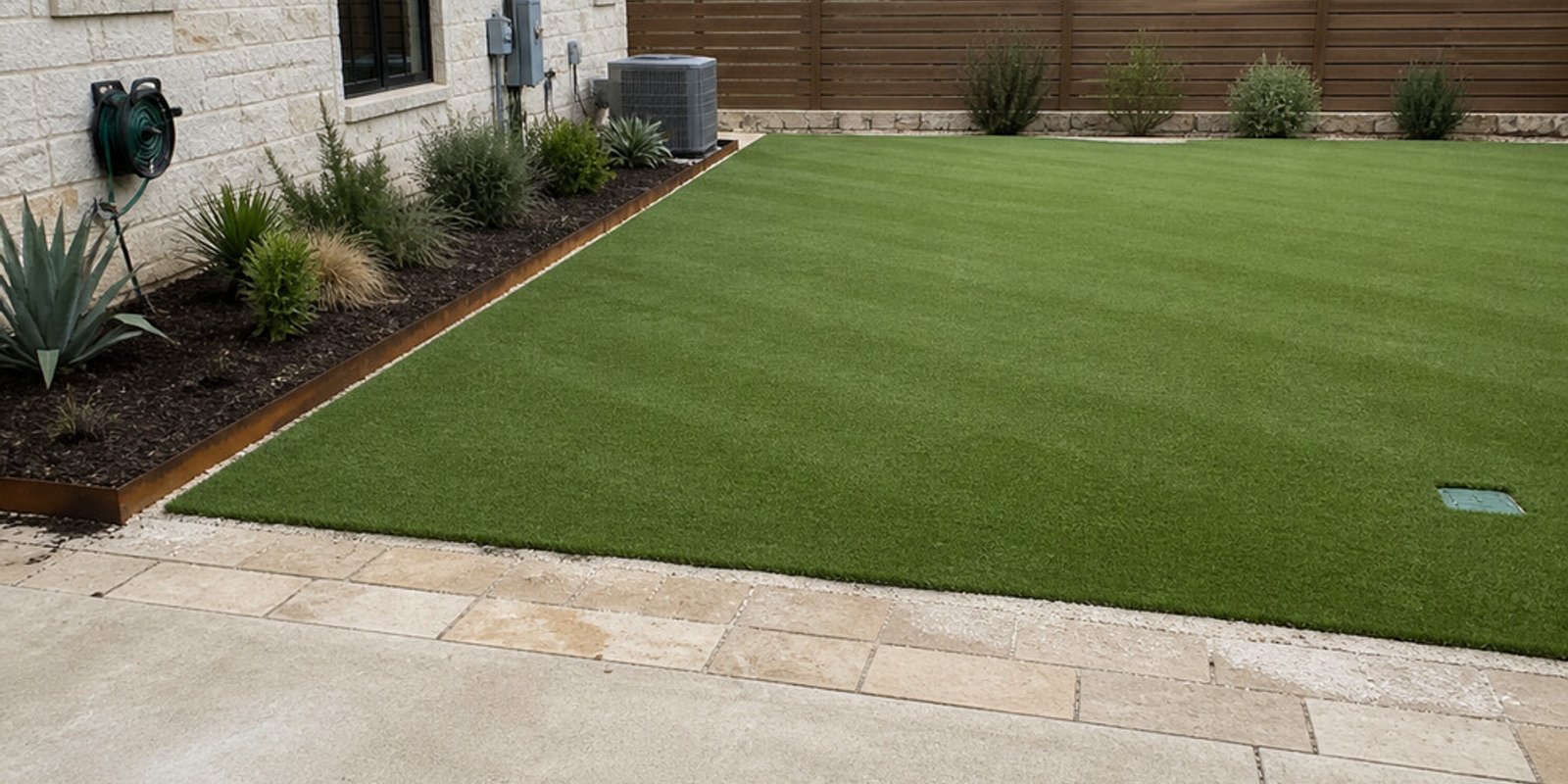
We install both. Our sod installation team lays St. Augustine, Zoysia, and Bermuda grass, and we build every artificial turf lawn on a compacted crushed-stone base. The short answer is that sod costs far less to put in, while turf uses no water to keep green. Which one wins depends on your shade, your pets, and the rules where you live.
How much does artificial turf cost in Austin compared with sod?
Sod costs much less up front. Turf usually costs several times more. These figures come from Lawn Love's 2026 national cost guides for artificial grass and sod, and they include materials and labor. They are not our quotes and not verified Austin prices.
- Artificial turf: $5.45 to $20 per square foot. For a 1,000-square-foot lawn, that works out to about $5,450 to $20,000 by our math, and Lawn Love's average is near $12,725.
- Sod: $1.70 to $2.60 per square foot, or $1,700 to $2,600 for 1,000 square feet.
- Sod grass alone, before labor: about $0.43 to $0.85 per square foot for Bermuda, $0.45 to $0.90 for St. Augustine, and $0.60 to $1.05 for Zoysia.
Labor drives most of a turf bill. Lawn Love says it makes up 50% to 60% of the total. The job includes removing the old lawn and soil and building a stone base, and that base matters on Austin clay. We dig out the clay and build a compacted crushed-stone base so the turf drains fast and stays level.
Is artificial turf cheaper than sod over time?
Sometimes. Turf saves on water and mowing, but it has to be replaced when it wears out.
Water is the big one in Austin. Austin Water says lawn grass typically needs about 1 inch of water a week in summer, and that a 500-square-foot lawn uses about 1,240 gallons a month. By that math, a 1,000-square-foot lawn needs close to 2,500 gallons a month in summer. Turf needs no irrigation, though you will still rinse it now and then.
Turf does not last forever. Lawn Love puts turf's lifespan at 10 to 25 years. A sod lawn needs regular mowing, feeding, and watering instead, whether you do the work or hire a lawn service.
If cutting water use is your main goal, look at Austin Water's WaterWise Landscape rebate. It pays up to $3,000 to turn healthy lawn into native plant beds, but artificial turf is not eligible, and work started before approval does not qualify. Our xeriscaping guide covers that route, and our xeriscape design service plans it.
Can new sod take root under Austin's watering rules?
Yes, but plan the watering before the sod shows up. As of September 2, 2025, Austin is in the Conservation Stage of its water rules. Austin Water's watering schedule sets these limits for homes:
- Automatic and manual sprinkler systems: one day a week
- Hose-end sprinklers and drip irrigation: two days a week
- Allowed hours: midnight to 10 a.m. or 7 p.m. to midnight
- Hand-held hose: allowed any time
New sod needs more than once a week. The Texas A&M AgriLife Extension sod guide says to water every 2 to 3 days so the soil stays moist 3 to 4 inches down. Above 80 degrees, new sod may need water daily until it roots. Austin Water lists a variance for new xeriscape plantings, but not one for new sod. So a summer install may mean hand-watering between your scheduled days. Rules get stricter in drought stages, and other water utilities set their own.
AgriLife also notes that warm-season sod laid in late fall or winter may not root well until spring and may need watering until then. These grasses also turn straw-colored after the first frost, so a winter lawn will look tan until spring. We install sod year-round and set the watering plan to the season. If your lawn and beds share sprinkler zones, our irrigation design work can split them.
Which sod fits your yard: St. Augustine, Zoysia, or Bermuda?
Match the grass to your sun, then to how hard you use the yard. AgriLife rates the three this way:
- St. Augustine: the most shade-tolerant warm-season grass. It handles drought less well than Bermuda or Zoysia, and it rates low for cold and foot traffic.
- Zoysia: moderate to high shade tolerance, very good drought tolerance, and moderate to high traffic tolerance. Palisades is one Zoysia variety sold as sod.
- Bermuda: very low to low shade tolerance, but very good to excellent drought tolerance and high traffic tolerance. It suits open, sunny yards that get heavy use.
Austin Water adds that Bermuda and Zoysia are more drought-tolerant than most St. Augustine varieties. It also warns that people tend to overwater them during dormancy to keep them green.
Under big live oaks, AgriLife's Travis County office puts it plainly: if a spot is too shady for St. Augustine, it is too shady for any warm-season grass. There, turf or planting beds may work better.

Two of our Google reviews come from homeowners we laid sod for. One says we found the grass that would work best for their yard and gave them detailed instructions to help it root.
Does artificial turf get too hot in an Austin summer?
It can. In a study by UNLV and the Desert Research Institute, green artificial turf reached a peak surface temperature about 69 degrees F hotter than watered natural grass, with readings as high as 169 degrees F. The researchers tested one product and noted that others may perform differently.
You can lower the heat, but you cannot remove it:
- Choose products made to reduce heat gain. Georgetown's residential turf permit, for example, asks for proof of heat-blocking features.
- Put turf where it gets afternoon shade from a tree or a structure.
- Rinse it before kids or pets play on a hot afternoon.
If your yard gets full afternoon sun and you want to walk on it barefoot in July, sod will likely feel more comfortable.
Is artificial turf or sod better for dogs?
It depends on the dog and the yard. Turf will not turn to mud or wear a bare path along the fence. It also stays covered in shady spots where grass struggles. But pet urine has to drain through it. We build turf on a drainage base that lets liquids pass straight through. Lawn Love says antimicrobial infill is a must if pets use the lawn as a bathroom. Plan to rinse the pet area often, especially in summer.
Sod is softer and cooler underfoot. If you choose sod for a busy dog yard, pick for traffic: AgriLife rates Bermuda high for traffic tolerance and St. Augustine low.
You can also split the yard: turf for a dog run or side yard, and sod for the open lawn.
Can your HOA or city limit artificial turf?
Yes, so check before you buy. The rules differ by city:
- HOAs: Texas Property Code Section 202.007 bars HOAs from prohibiting drought-resistant landscaping or water-conserving natural turf, or from unreasonably denying approval for it. The law names natural turf, not artificial turf. Your HOA's rules on synthetic grass still apply, so get approval in writing.
- Austin: In a November 2025 presentation, the city's Watershed Protection staff said city code is silent on artificial turf. They added that a draft staff interpretation treats its compacted base as impervious cover, the hard surface that counts against your lot's limit, and that past project reviews have varied. That same month, the Environmental Commission voted 8 to 0 to recommend that the city define turf as impervious cover in code and ban it, with some exceptions. As of this writing, we have not found that the City Council adopted those changes. Before you replace a large lawn, have your lot's impervious cover checked. Our driveway guide explains how those limits work.
- Lakeway: Lakeway's residential landscaping code caps artificial turf at 25% of the total landscape area. It also sets product and base standards, bans crumb rubber infill, and keeps turf out of the dripline of protected trees. If you live in Lakeway, design around that cap.
- Georgetown: Georgetown requires a Residential Artificial Turf Permit. The application calls for a professional engineer's sealed letter certifying that the turf lets rain soak in at the same rate as natural grass.
Other cities around Austin set their own rules, so ask yours before you sign a contract.
What should an artificial turf or sod quote include?
A good quote lets you compare bids line by line. For either one, look for:
- Square footage and a drawing of the area
- Removal and haul-off of the old lawn
- Grading so water drains away from your house
- Who calls 811. Texas law requires a call two business days before digging, even in your own backyard.
- Who handles any permit or HOA approval
- A written workmanship warranty
For artificial turf, also look for:
- The exact product, fiber type, face weight, and pile height
- Base material, depth, and how it will be compacted
- Drainage, edge restraints, and how the seams are joined
- Infill type, including antimicrobial infill if you have pets
- The manufacturer's warranty
For sod, also look for:
- Grass type and variety
- Soil prep: removing the old grass, loosening the clay, and any amendments
- Delivery timing, since AgriLife says sod does best when installed within 36 hours of harvest
- Rolling, the first deep watering, and a watering schedule that fits your city's rules
- Any sprinkler adjustments
A low sod price may cover the grass alone. AgriLife reminds buyers not to assume a sod grower will grade the site, fertilize, or install the grass.
Here is how we work. We walk your yard, check the sun through the day, and give you a free written estimate. If water is pooling, our land grading team fixes the slope before any lawn goes down.
Ready to choose the right lawn for your Austin yard?
Sod and turf can both look great. The right one depends on your shade, your water plan, your pets, and the rules for your street. Contact 512 Luxury Landscape Design to schedule a design consultation. We will walk your yard with you and price sod and turf side by side for the same space.